Focus on the manufacturing and export of functional sofas
-
 +86 18257273741
-
 [email protected]

 English
 Español
Industry News
 Home / News / Industry News / Manual Recliner, Electric Recliner & Lift Chair: Full Comparison Guide
 Manual Recliner, Electric Recliner & Lift Chair: Full Comparison Guide
 2026.04.03
 Industry News
Content
- 1 Understanding Recliner Chair Types: An Overview
- 2 Manual Recliner: Mechanism, Types, and Best Use Cases
- 3 Electric Recliner: Power Mechanism, Features, and Advantages
- 4 Lift Chair: Stand-Assist Mechanism, Classifications, and Medical Applications
- 5 Side-by-Side Comparison: Manual Recliner vs Electric Recliner vs Lift Chair
- 6 Upholstery, Fabric, and Material Considerations
- 7 How to Choose the Right Recliner for Your Needs
Understanding Recliner Chair Types: An Overview
Recliner chairs are among the most functionally diverse seating products on the market — ranging from simple manually operated lounge chairs to sophisticated power-driven lift chairs with programmable memory positions and integrated massage systems. The three principal categories — manual recliners, electric recliners, and lift chairs — serve distinct user needs and operate through fundamentally different mechanisms, making a direct feature-by-feature comparison essential for buyers, interior designers, and healthcare specifiers alike.
Choosing the wrong category is the most common and costly mistake in recliner procurement — a manual recliner that requires significant physical effort to operate is inappropriate for elderly or mobility-impaired users, while a lift chair's motorized stand-assist function adds unnecessary cost and complexity for a physically active user seeking a comfortable lounging chair for home entertainment. Understanding what differentiates each type at the mechanism, comfort, and application level is the foundation of a good purchasing decision.
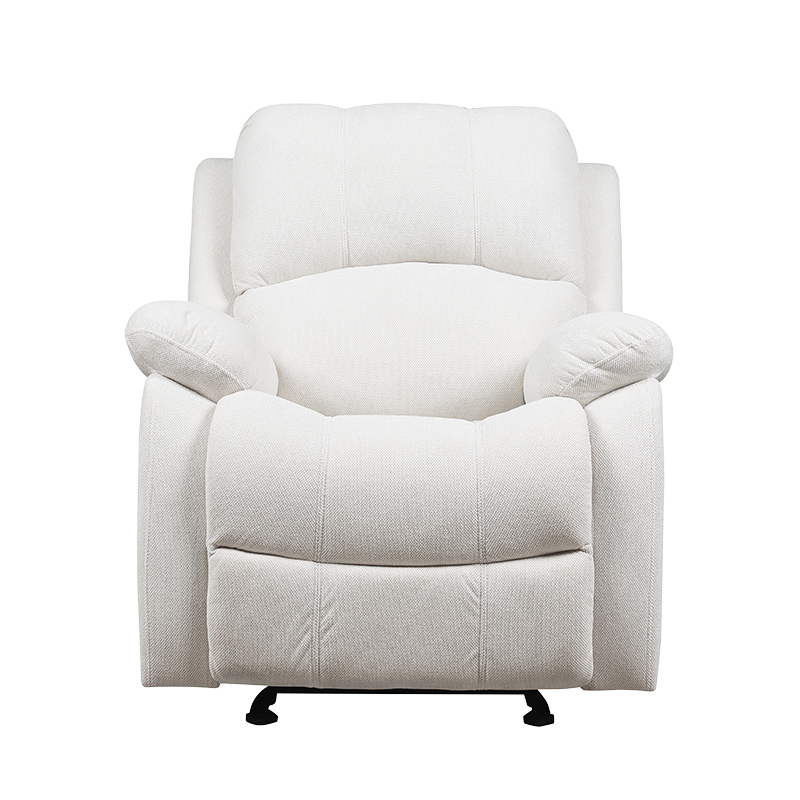
Manual Recliner: Mechanism, Types, and Best Use Cases
A manual recliner operates entirely through mechanical means — no electricity, motor, or battery is involved. The user activates the reclining mechanism by applying body weight or pulling a handle, which releases a locking mechanism and allows the backrest and footrest to move to the desired position.
Push-Back vs Pull-Handle Mechanisms
Manual recliners use one of two primary actuation systems. Push-back recliners require the user to press their body weight against the backrest to recline — there is no side handle or footrest extension; the chair's back tilts only. These offer a streamlined profile and are popular in contemporary furniture design where a traditional footrest is considered visually heavy. Pull-handle recliners — the classic configuration — use a side-mounted lever or handle to simultaneously release the backrest lock and extend a linked footrest (leg rest) to a fully raised position. Releasing the handle re-engages the lock at any angle within the recline range, allowing the user to hold intermediate positions.
A further variation is the wall-hugger recliner, which uses a forward-sliding seat mechanism so the chair moves toward the wall as it reclines, rather than backward. This allows full recline in rooms where only 10–15 cm of clearance exists behind the chair — a significant space-saving advantage over standard manual recliners that require 30–45 cm of clearance behind the backrest.
Recline Range and Positions
Most manual recliners offer a recline range from upright (approximately 90–100°) to a fully reclined position of 140–160°. The number of lockable positions varies by mechanism — basic spring-and-pawl systems offer two or three fixed positions (upright, TV position, full recline), while continuous-lock mechanisms allow the user to hold any angle within the full range. For users who spend extended time reading or watching television at a consistent intermediate angle, continuous-lock mechanisms are considerably more practical.
Who Manual Recliners Are Best Suited For
Manual recliners are the appropriate choice for physically active users who can comfortably push back against a chair or operate a side lever without difficulty, and for applications where power access is unavailable or inconvenient. They are also the standard specification for high-volume commercial seating environments — cinema auditoriums, sports stadium club seating, and waiting lounges — where the absence of electrical components reduces maintenance requirements and eliminates power infrastructure costs across large installations.
Structural Quality Indicators
The long-term durability of a manual recliner is determined primarily by its mechanism quality and frame construction. High-quality mechanisms use cold-rolled steel stampings with welded joints and hardened pivot pins, rated for 100,000+ actuation cycles. Budget mechanisms use thinner-gauge steel and cast zinc components at pivot points that fatigue and crack under repeated loading. Frame construction should use either solid hardwood (kiln-dried to below 10% moisture content) or high-gauge steel — corner-blocked and glued hardwood frames are considered the benchmark for upholstered recliner longevity, while welded steel frames are standard in commercial and contract-grade seating.
Electric Recliner: Power Mechanism, Features, and Advantages
An electric recliner — also called a power recliner — replaces the manual lever and spring mechanism with one or more low-voltage DC electric motors that drive linear actuators to move the backrest, footrest, and headrest independently and smoothly to any position within their full travel range. The user controls the chair through a wired handset, wireless remote, or integrated side panel buttons, and can stop the movement at any exact position — no body force is required at any stage of operation.
Single-Motor vs Dual-Motor vs Three-Motor Configurations
The number of motors in an electric recliner determines the independence of adjustment between different zones of the chair. Single-motor electric recliners move the backrest and footrest together in a linked action — as the back reclines, the footrest rises proportionally. This is the entry-level power configuration and provides smooth motorized operation without the flexibility of independent zone adjustment. Dual-motor recliners drive the backrest and footrest independently, allowing the user to raise the footrest while keeping the back upright (ideal for leg elevation to reduce lower limb swelling), or to recline the back while keeping the footrest down. Three-motor configurations add independent power adjustment of the headrest or lumbar support, providing the maximum level of posture customization — these are the standard specification in premium home theater seating and medical-grade recliners.
Memory Positions, USB Charging, and Integrated Features
Mid-range and premium electric recliners incorporate a range of convenience and comfort features that manual chairs cannot offer. Memory position buttons allow the user to save two or more preferred recline configurations — the actuators return the chair to the saved position at the press of a single button, eliminating the need to manually adjust each time. USB charging ports integrated into the armrest or side panel allow device charging without a separate power strip. Higher-specification models add heat and massage modules — typically vibration motors at lumbar, seat, and calf zones with multiple intensity settings — as well as Bluetooth connectivity for control via smartphone app.
Battery backup systems — a rechargeable lithium pack that powers the actuators for multiple cycles during a mains power outage — are an important safety feature to specify for electric recliners used by elderly or mobility-impaired users, ensuring the chair can always return to the upright position regardless of power availability.
Power Requirements and Installation
Electric recliners require a standard mains outlet (110–120V in North America; 220–240V in most other markets) within cable reach of the chair's position. The chair's transformer and motor draw relatively modest power — typically 50–150W during actuation and near zero in standby — but the cable management requirement must be factored into room layout planning. Cordless zones or concealed cable channels in the wall are the cleanest solution for permanent installations; in-room cable management trays are a practical alternative for rental or flexible-layout environments.
Lift Chair: Stand-Assist Mechanism, Classifications, and Medical Applications
A lift chair is a specialized category of power recliner that incorporates an additional lifting mechanism — typically a heavy-duty linear actuator mounted beneath the seat — that tilts the entire chair frame forward and upward, raising the seated occupant to a near-standing position. This stand-assist function is the defining feature that separates lift chairs from standard electric recliners and represents a significant functional benefit for users with limited lower-limb strength, arthritis, post-surgical mobility restrictions, or neurological conditions affecting the ability to stand from a seated position independently.
Lift Chair Position Classifications
Lift chairs are classified by the number of recline positions their mechanism supports, which in turn determines their suitability for different therapeutic and comfort applications:
- Two-position lift chairs recline to approximately 45° from upright — a comfortable TV-watching or reading position — but do not reach a fully flat or near-flat position. These are entry-level lift chairs suited primarily for daytime sitting and stand-assist use, not for sleeping or extended recumbent rest.
- Three-position lift chairs extend to a full-recline position of approximately 135–140°, allowing the user to rest comfortably in a near-sleeping position. The footrest and backrest move in a linked action as in a single-motor recliner. This is the most widely specified configuration for home care and assisted living environments.
- Infinite-position (dual-motor) lift chairs provide fully independent backrest and footrest control, identical to a dual-motor electric recliner, combined with the lifting function. The chair can achieve a true zero-gravity position — in which the legs are raised above the heart level and the back is reclined to approximately 120° — which reduces lumbar disc pressure and promotes venous return from the lower extremities. These are the clinically preferred configuration for users managing chronic edema, heart failure, or post-operative lower limb recovery.
- Trendelenburg lift chairs extend beyond flat to a head-down, feet-elevated position exceeding 180° recline. These are specialized medical configurations used in clinical and home healthcare settings for specific therapeutic indications under professional guidance.
Weight Capacity and Sizing Considerations
Lift chairs carry a heavier structural and actuator load than standard recliners because the lift mechanism must support the full occupant weight during the tilt-and-rise cycle. Standard lift chairs are rated for occupant weights of 135–160 kg (300–350 lb). Heavy-duty and bariatric lift chairs are available with capacity ratings up to 270–360 kg (600–800 lb), featuring reinforced steel frames, wider seat widths (560–660 mm versus the standard 480–530 mm), and dual heavy-duty actuators. Matching the chair's weight rating and seat width to the user's body dimensions is critical — an undersized chair creates discomfort at the armrests and reduces the effectiveness of the lift mechanism, while an oversized chair fails to provide the lateral support needed for safe stand-assist.
Medicare and Insurance Coverage for Lift Chairs
In the United States, the lift mechanism component of a lift chair may qualify for partial reimbursement under Medicare Part B as a Seat Lift Mechanism (HCPCS code E0627) when prescribed by a physician as medically necessary for a qualifying musculoskeletal or neurological condition. The upholstered chair itself is not covered — only the mechanism. Reimbursement amounts are fixed by the Medicare fee schedule and typically cover a portion of the mechanism's cost. Buyers should confirm current reimbursement rates with their DME (Durable Medical Equipment) supplier and verify that the specific model carries the appropriate Medicare product code before purchase.
Side-by-Side Comparison: Manual Recliner vs Electric Recliner vs Lift Chair
| Feature | Manual Recliner | Electric Recliner | Lift Chair |
|---|---|---|---|
| Actuation | Manual lever or push-back | Electric motor + handset | Electric motor + lift actuator |
| Stand-Assist Function | No | No | Yes — key feature |
| Independent Zone Control | No | Yes (dual/triple motor) | Yes (infinite position models) |
| Power Required | No | Yes (mains outlet) | Yes (mains outlet) |
| Physical Effort Required | Moderate | Minimal | Minimal |
| Typical Price Range | Lower | Mid to high | Mid to high |
| Maintenance Complexity | Low — no electrical parts | Moderate — motor/actuator | Moderate to high |
| Best For | Active users, commercial use | Home comfort, home theater | Elderly, mobility-impaired, post-surgical recovery |
Upholstery, Fabric, and Material Considerations
Across all three recliner types, the upholstery material affects not only aesthetics and comfort but also durability, cleanability, and suitability for specific user groups — factors that are particularly important when specifying lift chairs for elderly users or healthcare environments.
Full-grain and top-grain leather remain the premium choice for home recliners, offering a soft hand feel that improves with age, natural breathability, and ease of surface cleaning. Genuine leather is rated for 15,000–30,000 Martindale rub cycles in furniture-grade hides, making it suitable for moderate daily-use environments. Bonded leather and PU (polyurethane) leather offer a visually similar appearance at lower cost but delaminate over time — typically within 3–7 years under regular use — making them a poor long-term value in frequently used recliners.
Performance fabrics — solution-dyed polyester, olefin, and microfiber constructions with abrasion ratings above 50,000 Martindale cycles — are the preferred specification for high-use residential recliners and commercial applications. Many performance fabrics now incorporate moisture-barrier or antimicrobial treatments, making them particularly appropriate for lift chairs used in incontinence management or post-surgical recovery contexts.
For lift chairs specifically, heat- and moisture-wicking seat covers are an important comfort feature for users who spend extended periods in the chair. Breathable 3D spacer fabrics at the seat and backrest — which promote air circulation between the user and the upholstery surface — significantly reduce perspiration discomfort during prolonged occupancy and lower the risk of pressure-related skin irritation in users with reduced mobility.
How to Choose the Right Recliner for Your Needs
The correct recliner type follows directly from the primary user's physical capabilities, the intended use environment, and the features that will genuinely be used rather than simply specified on a datasheet.
If the user is physically active, has no difficulty standing from a standard seat height, and the chair will be used in a room without convenient power access or in a commercial setting requiring minimal maintenance — a manual recliner is the most practical and cost-effective choice. Invest the budget in mechanism quality and frame construction rather than features that add no functional value for this user profile.
If the user wants effortless position adjustment, intends to use the chair for extended periods of relaxation or sleeping, values independent backrest and footrest control for reading, leg elevation, or zero-gravity positioning, and a power outlet is conveniently accessible — a dual-motor electric recliner is the appropriate specification. Prioritize actuator quality, handset ergonomics, and battery backup provision.
If the user experiences difficulty rising from a seated position due to age, arthritis, post-surgical recovery, or any condition affecting lower-limb strength or balance — a lift chair is not a luxury but a functional necessity. Select the position classification based on whether the chair will be used primarily for daytime sitting (three-position is sufficient) or for extended rest and therapeutic positioning (infinite-position dual-motor is the correct specification). Confirm seat width and weight capacity match the user's dimensions before any other feature consideration.
LET'S TALK

Bai Shuiwan Industrial Park, Tian Huangping Town, Anji County, Huzhou City, Zhejiang Province, China
More About Us 
-
+86 18257273741
-
[email protected]
CONTACT US
Copyright © Anji Xuanbo Household Co., Ltd. All Rights Reserved.
Custom Modern Upholstered Sofa Manufacturers


