Focus on the manufacturing and export of functional sofas
-
 +86 18257273741
-
 [email protected]

 English
 Español
Industry News

Recliner Chair Types, Mechanisms and Buying Tips
 2026.07.10
 Industry News
Content
Manual vs Power Recliner
A manual recliner reclines when the user pulls a side lever or pushes back against the backrest, using body weight and a spring-loaded mechanical linkage to shift position. A power recliner uses an electric motor, controlled by a button or remote, to move the backrest and footrest independently or in sync, often stopping at any point in the range rather than only at fixed positions.
| Factor | Manual Recliner | Power Recliner |
|---|---|---|
| Operation | Lever or push-back, fixed positions | Button or remote, infinite positions |
| Power source | None needed | Requires an outlet nearby |
| Weight | Lighter, easier to move | Heavier, motor and battery backup add bulk |
| Maintenance | Mechanical only, simpler repairs | Motor and wiring can fail, pricier to service |
| Typical price range | Lower | Higher, often 30–60% more |
Manual and power recliners compared across the factors that matter most to buyers.
How Does a Manual Recliner Work
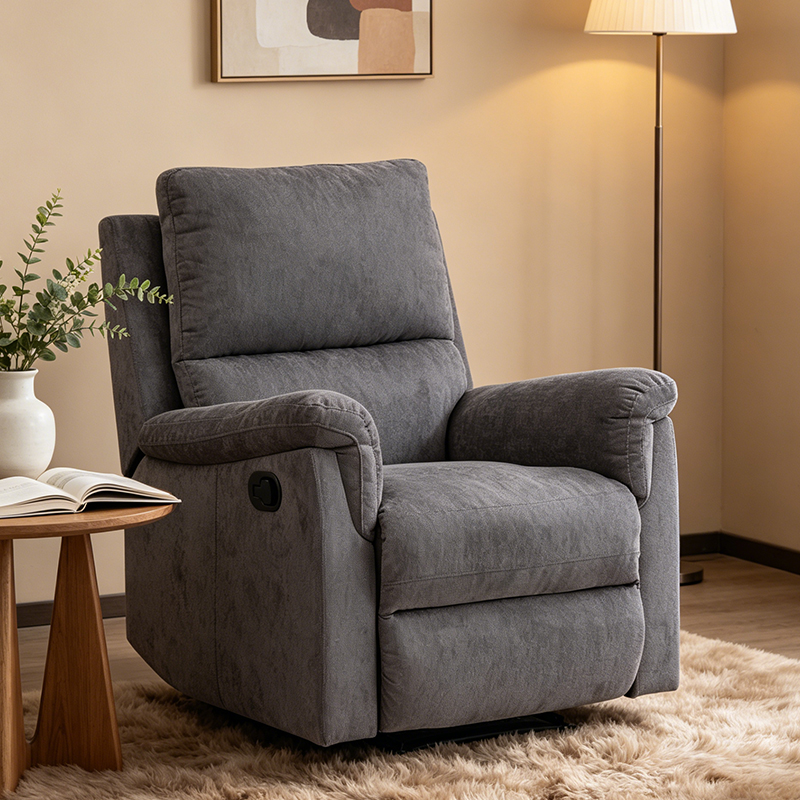
A manual recliner relies on a mechanical linkage — usually a ratchet mechanism or a spring-tension system connected to a side lever. Pulling the lever releases a catch, letting the chair's frame rotate the footrest up and the backrest down along a set of pivot points. Releasing the lever at a given position locks the frame in place using a ratchet or notch system, or the chair holds position through spring tension and the sitter's body weight.
Some manual recliners use a "push-back" mechanism instead of a lever: leaning back against the chair triggers the footrest to rise automatically, without any separate handle. Because the entire mechanism is mechanical, with no motor or wiring, manual recliners tend to have fewer parts that can fail and no dependency on a nearby power outlet, which is part of why they remain the more common choice for stationary living-room seating.
Recliner Chair Mechanism Types
Beyond the manual/power distinction, recliners use a few different frame mechanisms that affect how much wall clearance they need and how the seat moves:
- Rocker mechanism — the chair rocks gently on a curved base in addition to reclining, popular for nursery and living-room use.
- Wall-hugger (wall-saver) mechanism — the seat slides forward as it reclines, so the chair needs only a few inches of clearance from the wall instead of the foot or more required by standard recliners.
- Swivel mechanism — the seat rotates on its base independent of the reclining action, letting the user turn toward a TV, window, or conversation without standing up.
- Glider mechanism — the chair moves back and forth on a smooth track rather than rocking on a curved base, giving a steadier, quieter motion.
Swivel Recliner vs Rocker Recliner
A swivel recliner rotates 360 degrees on its base, which makes it well suited to open floor plans or rooms with multiple focal points, since the chair can face the TV, a window, or a conversation area without being physically repositioned. A rocker recliner instead moves back and forth on a curved base, producing a gentle rocking motion that many people find soothing but that doesn't allow rotation.
Some models combine both functions into a swivel-rocker recliner, offering rotation and rocking in one chair. The trade-off is usually price and mechanism complexity: combination models cost more and have more moving parts than a chair built for just one function.
Swivel Recliner Chair Benefits
- Faces multiple directions without repositioning the chair, useful in rooms that serve more than one purpose.
- Reduces strain on the lower back and hips, since the sitter can turn using the base instead of twisting the torso.
- Works well in smaller or oddly shaped rooms where a fixed-facing chair would limit sightlines.
- Makes it easier to join conversation or hand items to someone nearby without standing up.
How to Choose a Recliner Chair
Start with available space and clearance rather than style. Measure the distance from the intended spot to the nearest wall; a standard recliner needs 12–18 inches of clearance to fully recline, while a wall-hugger design needs as little as 3–6 inches.
- Confirm the mechanism type — manual, power, rocker, swivel, or wall-hugger — matches how and where the chair will be used.
- Check weight capacity and seat dimensions against the primary user's height and build; an undersized frame will feel cramped and wear out faster.
- Test the recline range in person if possible — some chairs stop at 90–130 degrees, while true lay-flat models recline close to 180 degrees.
- Consider upholstery based on household needs — pets, kids, and high-humidity climates each favor different materials, covered further below.
- Factor in long-term maintenance access, especially for power recliners, which may need occasional motor or wiring service.
Leather vs Fabric Recliner
| Factor | Leather | Fabric |
|---|---|---|
| Cleaning | Wipes clean, resists spills and stains | Absorbs spills, may need spot cleaning or steam |
| Comfort in heat | Can feel warm or sticky in humid climates | Breathes better, feels cooler against skin |
| Durability with pets | Resists claw snags better if top-grain | More prone to snagging and pilling |
| Typical cost | Higher, especially top-grain or full-grain | Lower to mid-range |
Leather and fabric upholstery compared for recliner chairs.
Manual Recliner Maintenance
- Tighten loose bolts and screws in the frame every few months, since repeated reclining gradually works fasteners loose.
- Apply a small amount of silicone-based lubricant (not oil-based, which attracts dust) to visible metal hinge points if the mechanism starts to squeak or stick.
- Vacuum the mechanism area under and behind the seat regularly, since debris buildup is a common cause of jammed or stiff reclining action.
- Avoid forcing the lever or footrest if it resists movement; forcing a jammed mechanism is a leading cause of bent linkage rods and broken ratchets.
Best Recliner for Small Spaces
For small rooms or apartments, wall-hugger recliners are generally the strongest fit, since their sliding-seat mechanism lets the chair fully recline just inches from a wall instead of the 12–18 inches standard models require. Compact swivel recliners are a second option, since rotating the chair toward open floor space can substitute for the deep backward clearance a traditional recliner needs.
When floor space is limited, checking the chair's footprint in both upright and reclined positions — not just its upright dimensions — avoids the common mistake of a recliner that fits the room until someone actually reclines it.
LET'S TALK

Bai Shuiwan Industrial Park, Tian Huangping Town, Anji County, Huzhou City, Zhejiang Province, China
More About Us 
-
+86 18257273741
-
[email protected]
CONTACT US
Copyright © Anji Xuanbo Household Co., Ltd. All Rights Reserved.
Custom Modern Upholstered Sofa Manufacturers


