Focus on the manufacturing and export of functional sofas
-
 +86 18257273741
-
 [email protected]

 English
 Español
Industry News

Manual Swivel Recliner Chairs: Buying Guide & Durability Tips
 2026.07.03
 Industry News
Content
What Determines Comfort and Durability in Manual Swivel Recliner Chairs
Foam density, not just thickness, is what determines whether manual swivel recliner chairs stay comfortable after years of daily use. High-resiliency foam in the 1.8 to 2.5 lb/ft³ density range holds its shape through thousands of sit-and-recline cycles, while cheaper low-density foam compresses permanently within a year or two, leaving a noticeable body impression in the seat cushion. Seat foam typically needs a higher density than back and arm cushions, since it bears the most sustained weight and sees the most direct pressure over time.
Frame material has an outsized effect on how long the chair holds together under repeated reclining stress. Kiln-dried hardwood frames, joined with dowels, corner blocks, and wood glue rather than just staples or nails, resist the racking motion of reclining far better than softwood or particleboard frames, which can crack or loosen at the joints after a few years of regular use. Metal reinforcement at the high-stress points — where the recline mechanism attaches to the frame — adds meaningful durability on chairs used multiple times daily.
Weight capacity ratings, usually printed on a manufacturer's spec sheet, reflect more than just how much the chair can hold statically. A chair rated for 300 lbs is engineered with enough margin in the frame, springs, and mechanism to handle the dynamic loading of someone dropping into the seat or shifting weight while reclined, not just the static weight of sitting still — which is why buying with some margin above actual body weight extends the chair's working life.
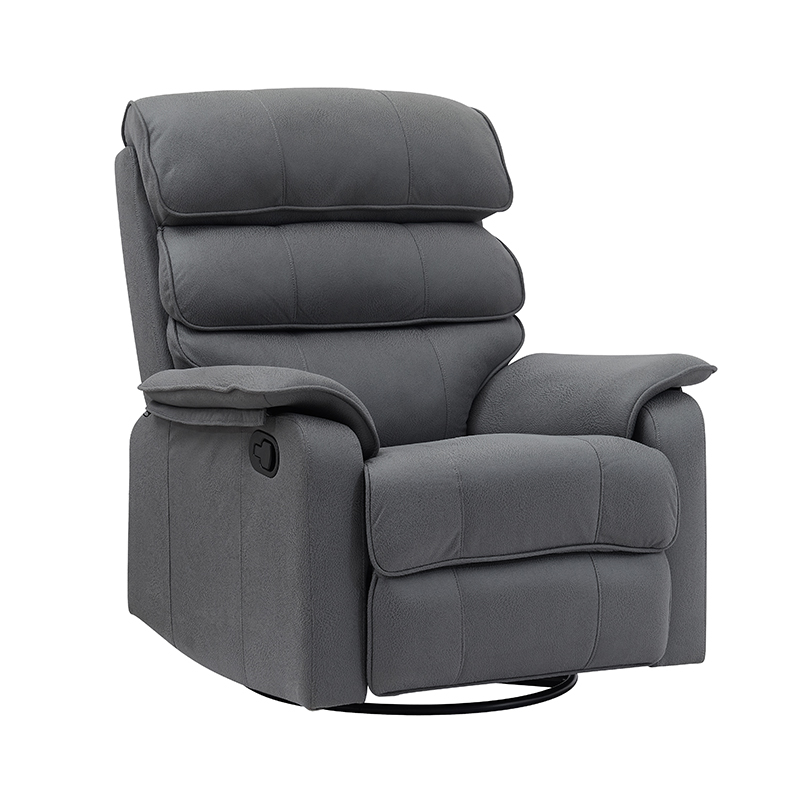
Frame Construction and Swivel Mechanism: What Actually Holds Up
The swivel base is one of the most mechanically stressed components on manual swivel recliner chairs, since it absorbs rotational torque every time the chair turns under load. A sealed ball-bearing swivel plate rotates smoothly for years without lubrication, while a simple bushing-style swivel can develop a gritty, resistant feel after heavy use as the bushing material wears down. Higher-quality chairs typically use a steel swivel plate bolted directly to the frame rather than a lighter stamped-metal version prone to flexing under weight.
Sinuous spring or eight-way hand-tied spring systems in the seat base both outperform basic webbing-only construction in terms of long-term support and even weight distribution. Sinuous springs offer a good balance of cost and durability for most manual recliners, while eight-way hand-tied springs, more common on premium models, provide slightly more even flex across the seat but add significantly to manufacturing cost and chair weight.
The manual recline handle or lever mechanism itself should move with consistent, even resistance rather than feeling loose or catching partway through the motion. A mechanism with a solid, positive lock at each recline position prevents the chair from creeping back to upright under body weight, which is a common complaint with lower-quality ratchet mechanisms that lose their hold after repeated use.
Comparing Upholstery Materials
Upholstery choice affects both the day-to-day feel of the chair and how well it holds up to spills, pet claws, and sun exposure over time. The right material depends heavily on household conditions rather than appearance alone.
| Material | Best For | Drawback |
|---|---|---|
| Top-grain leather | Long-term durability, easy wipe-down cleaning | Higher cost, can feel cold in winter |
| Faux leather | Budget-conscious buyers, easy cleaning | Cracks and peels faster than real leather |
| Woven fabric | Breathability, softer everyday feel | Absorbs spills, harder to clean |
| Performance/stain-resistant fabric | Households with kids or pets | Limited color and texture options |
Comparison of common recliner upholstery materials by suitability and drawback.
Reclining Mechanism Types and How They Affect Everyday Use
Manual recliners rely on either a side-mounted lever or a push-back mechanism activated by body weight, and the choice affects how naturally the chair fits into daily use. A lever mechanism gives precise control over recline angle and locks reliably at the chosen position, which suits anyone who prefers a specific, repeatable recline setting. A push-back mechanism, which reclines when the sitter leans back with enough force, feels more intuitive for casual use but generally offers fewer distinct locked positions.
Footrest deployment on manual swivel recliner chairs typically happens automatically as the backrest reclines, linked through the same internal mechanism, rather than requiring a separate motion. The footrest should extend smoothly without excessive force and return flush against the chair base when not in use — a footrest that doesn't fully retract can create a tripping hazard and also signals a mechanism that's beginning to wear or was poorly aligned during assembly.
Rocking function, offered on some swivel recliner models as an additional feature, uses a separate glider mechanism at the base independent from the recline function itself. Chairs combining swivel, rock, and recline in one unit generally cost more and have more moving parts that can eventually need adjustment, so buyers who only use one or two of these functions regularly may get better long-term value from a simpler mechanism focused on just the features they'll actually use.
Sizing, Placement, and Maintenance Considerations
Clearance space behind and to the sides of the chair is easy to overlook until the chair is already in the room. A fully reclined chair with footrest extended typically needs 18 to 24 inches of clearance behind the backrest and additional space to the side for the swivel motion, so measuring the intended spot with these dimensions in mind — not just the chair's footprint when upright — prevents a frustrating return or rearrangement after delivery.
Seat height and depth should match the primary user's body proportions rather than a generic "one size fits most" assumption. A seat that's too deep leaves shorter users unable to sit back fully without their legs dangling uncomfortably, while a seat that's too shallow can feel unsupportive for taller users. Testing the recline angle and footrest length in person, when possible, catches fit issues that dimensions alone don't always reveal.
Routine maintenance mostly comes down to keeping the mechanism free of dust and debris and periodically checking that frame bolts haven't loosened from repeated use. A light application of dry lubricant on visible metal mechanism parts, following the manufacturer's guidance, keeps the recline and swivel motion smooth without attracting dust the way heavier oils can.
LET'S TALK

Bai Shuiwan Industrial Park, Tian Huangping Town, Anji County, Huzhou City, Zhejiang Province, China
More About Us 
-
+86 18257273741
-
[email protected]
CONTACT US
Copyright © Anji Xuanbo Household Co., Ltd. All Rights Reserved.
Custom Modern Upholstered Sofa Manufacturers


