Focus on the manufacturing and export of functional sofas
-
 +86 18257273741
-
 [email protected]

 English
 Español
Industry News

Manual Recliner Corner Sofa: Space, Comfort & What to Look For
 2026.06.22
 Industry News
Content
- 1 What Makes a Manual Recliner Corner Sofa Different
- 2 Reclining Mechanisms: Handle, Push-Back, and Wall-Hugger
- 3 Configuration Options and Seat Count
- 4 Upholstery Materials: Fabric vs Leather vs Faux Leather
- 5 Frame and Suspension: What Determines Long-Term Comfort
- 6 Room Sizing and Placement Guidance
- 7 Buying Considerations: Warranty, Returns, and Testing
What Makes a Manual Recliner Corner Sofa Different
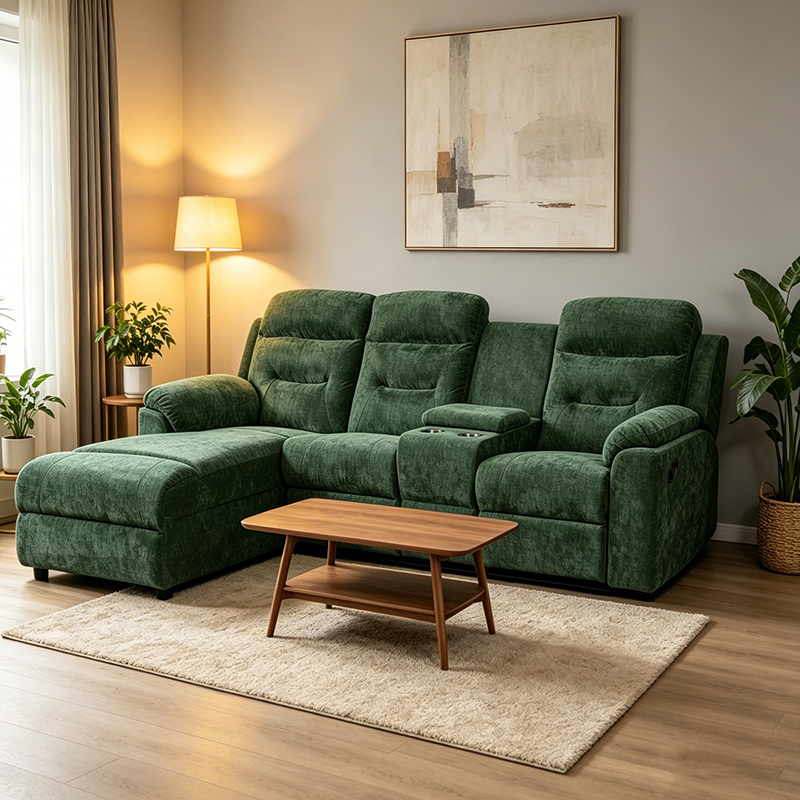
A manual recliner corner sofa combines two functions that buyers often search for separately: the space-maximising layout of a corner (L-shaped) sofa and the adjustable backrest or footrest of a recliner. Unlike powered models, the reclining mechanism is activated by a side handle or push-back action — no wiring, no charging, no motor maintenance.
The practical appeal is straightforward. Corner configurations seat more people than a standard three-seater of equivalent footprint, and reclining seats on a corner sofa are typically positioned at the ends or corners, leaving the central seats as standard fixed seating. This hybrid layout suits households where different occupants have different seating preferences.
Manual recliners are also considerably lighter and easier to relocate than motorised equivalents, which matters when moving home or rearranging a room.
Reclining Mechanisms: Handle, Push-Back, and Wall-Hugger
Most manual recliner corner sofas use one of three mechanisms, each with distinct ergonomic and spatial trade-offs:
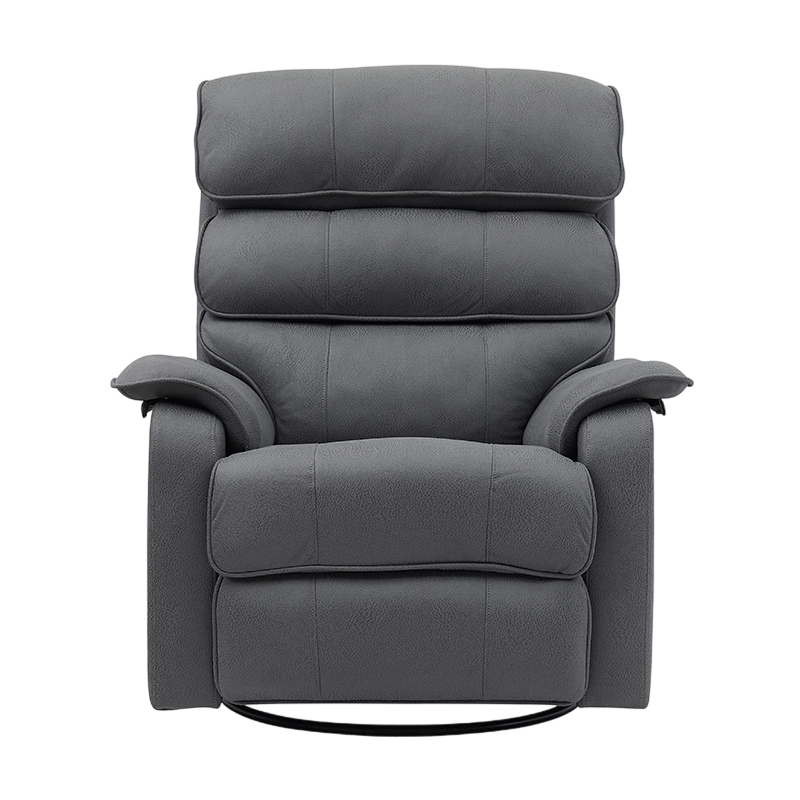
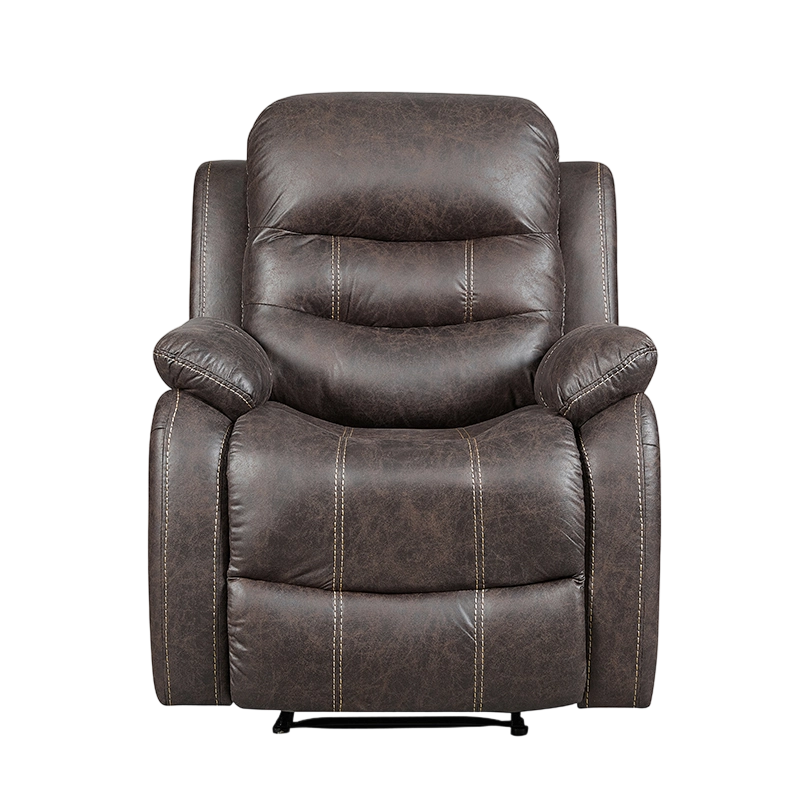
- Side-handle pull: A lever on the outer side of the reclining seat unlocks the footrest independently, while the backrest reclines by body pressure. This is the most common mechanism and offers the most intuitive operation.
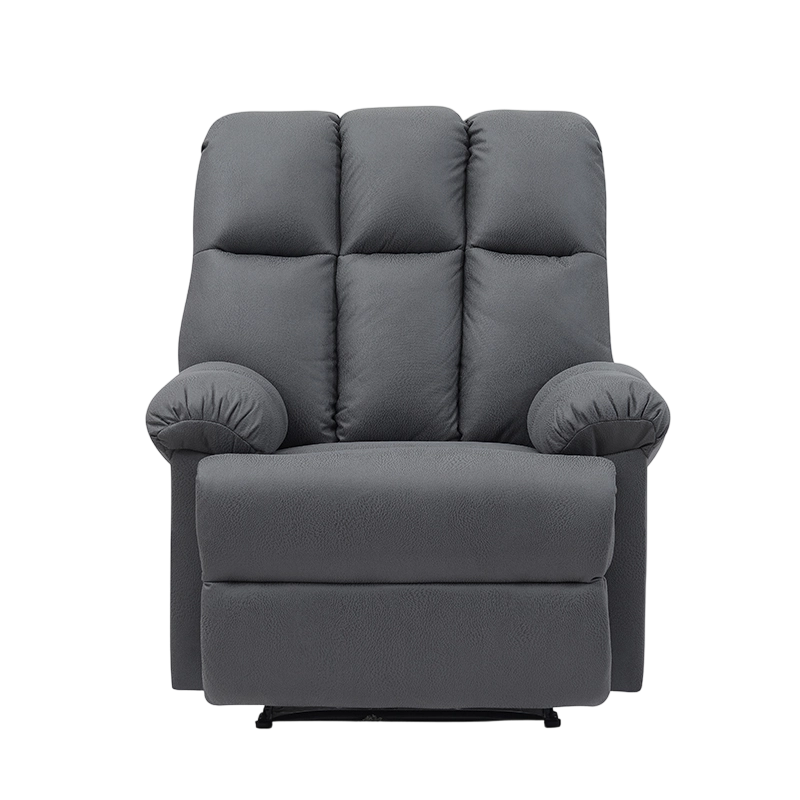
- Push-back: The user pushes their weight into the backrest to recline. There is no footrest lever — the legrest extends as the back lowers. This design has fewer moving parts and tends to be more compact when closed.
- Wall-hugger (space-saver): The seat base slides forward as the back reclines, reducing the clearance required behind the sofa. A standard recliner needs 30–45 cm of wall clearance to reach full recline; a wall-hugger can operate with as little as 10 cm.
For a corner sofa placement — where the back section typically sits against two walls — the wall-hugger mechanism is often the most practical choice, particularly in medium-sized living rooms.
Configuration Options and Seat Count
Corner sofas are sold in modular or fixed configurations. Understanding the naming convention helps when comparing models across different retailers.
| Configuration | Typical Seat Count | Recliner Positions | Approx. Footprint |
|---|---|---|---|
| 2-seater + corner + 1 recliner | 3–4 | 1 end | 220 × 150 cm |
| 3+2 corner with 2 recliners | 5 | Both ends | 270 × 190 cm |
| 5-seater corner with 3 recliners | 5–6 | Both ends + 1 mid | 300 × 200 cm |
Modular designs allow buyers to specify which side the chaise or corner falls on (left-hand facing or right-hand facing), which is critical for rooms with fixed architectural features such as bay windows, fireplaces, or doorways.
Upholstery Materials: Fabric vs Leather vs Faux Leather
The upholstery choice on a manual recliner corner sofa affects durability, maintenance, tactile comfort, and price more than almost any other variable. Each material class has genuine advantages and genuine limitations.
Fabric
Woven fabric — including chenille, velvet, and performance microfibre — is the most thermally comfortable option. It does not retain cold in winter or become sticky in summer the way leather can. Performance fabrics treated with stain-resistant coatings (such as Aquaclean or similar technologies) are increasingly common in corner sofas due to the high-use nature of the format. The main trade-off is that fabric is harder to wipe clean from spills and can accumulate pet hair more visibly than smooth surfaces.
Full Leather
Genuine leather is the most durable upholstery for a recliner specifically, because the seat areas subject to high friction — headrests, armrests, and the crease zones of reclining seats — hold up better under repeated movement than fabric or bonded alternatives. Full leather corner sofas are typically priced above £1,500–£2,000 for a five-seat configuration. Corrected-grain leather is the most practical mid-tier option: it is more uniform in colour and more resistant to scuffs than full aniline leather.
Faux Leather (PU / Bonded)
Faux leather delivers a similar visual result at a significantly lower price point and wipes clean easily. The risk with cheaper bonded leather is delamination — the top layer peeling from the base fabric — which typically appears within three to five years in high-use areas. Higher-grade PU products labelled as "corrected PU" or "air leather" are more resistant to this issue and remain an acceptable budget compromise.
Frame and Suspension: What Determines Long-Term Comfort
On a corner sofa with integrated recliners, frame rigidity matters more than on a standard sofa because the reclining mechanism introduces repeated mechanical stress at the joint between the reclining module and the fixed frame. Key indicators of frame quality include:
- Kiln-dried hardwood (beech or birch) for the base frame. This resists warping from humidity changes better than softwood alternatives.
- Sinuous (S-spring) or 8-way hand-tied coil suspension in the fixed seats. S-springs are adequate for most domestic use; hand-tied coils are more expensive but distribute weight more evenly over time.
- High-resilience (HR) foam rated above 30 kg/m³ in the seat cushions. Foam density is the single biggest determinant of how long cushions hold their shape under daily use.
Some manufacturers publish foam density figures; others do not. A simple heuristic: if a five-seat manual recliner corner sofa is priced below £600, it is unlikely to use HR foam above 28 kg/m³, which typically means noticeable compression within 18–24 months of regular use.
Room Sizing and Placement Guidance
The most common mistake when buying a corner sofa — recliner or otherwise — is purchasing before measuring the room with the door swing, radiator positions, and traffic flow paths accounted for. For a manual recliner corner sofa specifically, three measurements matter:
- Delivery access: Most large corner sofas are delivered in sections, but check whether the widest individual section clears your doorways and stairwell. Standard UK interior door width is 762 mm; door frames reduce the clear opening to approximately 710 mm.
- Reclining clearance: Mark on the floor where the footrest will extend to when fully open. A person reclined at full extension needs approximately 60–70 cm of clear space in front of the sofa.
- Wall clearance behind the corner: For non-wall-hugger models, allow at least 35–40 cm behind each reclining seat position. For wall-hugger models, 10–15 cm is typically sufficient.
A useful floor-planning approach is to tape out the sofa dimensions on the room floor before purchase. This takes less than ten minutes and reveals clearance conflicts that are easy to miss when working only from a floor plan or product image.
Buying Considerations: Warranty, Returns, and Testing
Manual recliner mechanisms are mechanical assemblies with more moving parts than a fixed sofa. The mechanism warranty is therefore an important buying criterion, separate from the frame and upholstery warranty. Look for a minimum two-year mechanism warranty; five years is offered by higher-quality manufacturers and reflects genuine confidence in the component build.
Return policies on large upholstered furniture vary significantly. Under UK consumer rights law, sofas ordered online are subject to the 14-day right to return under the Consumer Contracts Regulations, provided the product has not been made to order. Custom configurations — including bespoke fabric choices or non-standard dimensions — are frequently excluded from this right, so confirming the returns policy before ordering a customised configuration is essential.
Where possible, testing the recliner action in a showroom remains the most reliable way to assess mechanism smoothness, seat depth, and headrest positioning before committing to a large purchase.
LET'S TALK

Bai Shuiwan Industrial Park, Tian Huangping Town, Anji County, Huzhou City, Zhejiang Province, China
More About Us 
-
+86 18257273741
-
[email protected]
CONTACT US
Copyright © Anji Xuanbo Household Co., Ltd. All Rights Reserved.
Custom Modern Upholstered Sofa Manufacturers


