Focus on the manufacturing and export of functional sofas
-
 +86 18257273741
-
 [email protected]

 English
 Español
Industry News

Electric Power Lift Recliner Chairs: Manual vs. Heavy Duty Guide
 2026.04.15
 Industry News
Content
- 1 Manual Reclining Lift Chair vs. Power Lift Recliner: Which One Do You Actually Need?
- 2 What Makes a Heavy Duty Power Lift Recliner Different
- 3 How Electric Power Lift Recliner Chairs Work
- 4 Choosing Electric Recliner Chairs With Lift: A Practical Buyer's Guide
- 5 Common Problems With Power Lift Recliners and How to Avoid Them
Manual Reclining Lift Chair vs. Power Lift Recliner: Which One Do You Actually Need?
A manual reclining lift chair uses a hand-operated lever or push-back mechanism to recline the seat, while a power lift recliner relies on an electric motor to tilt the entire chair forward and assist the user to a standing position. For most seniors or users with limited mobility, the electric version offers a clear functional advantage — but the manual variant remains relevant for users who want a lower price point and have sufficient upper-body strength to operate the recline independently.
The core distinction lies in the lift mechanism itself. Manual recliners do not lift — they recline. The term "manual reclining lift chair" is sometimes used loosely in retail to describe chairs that recline manually but still include a basic lift assist. Always confirm whether the lift function is motorized before purchase, as the two are frequently conflated in product listings.
Key considerations when choosing between the two types:
- User's ability to push up from a seated position independently
- Whether the chair will be used after surgery or during rehabilitation
- Budget constraints — manual models typically cost 30–50% less than comparable power units
- Access to a power outlet near the intended placement location
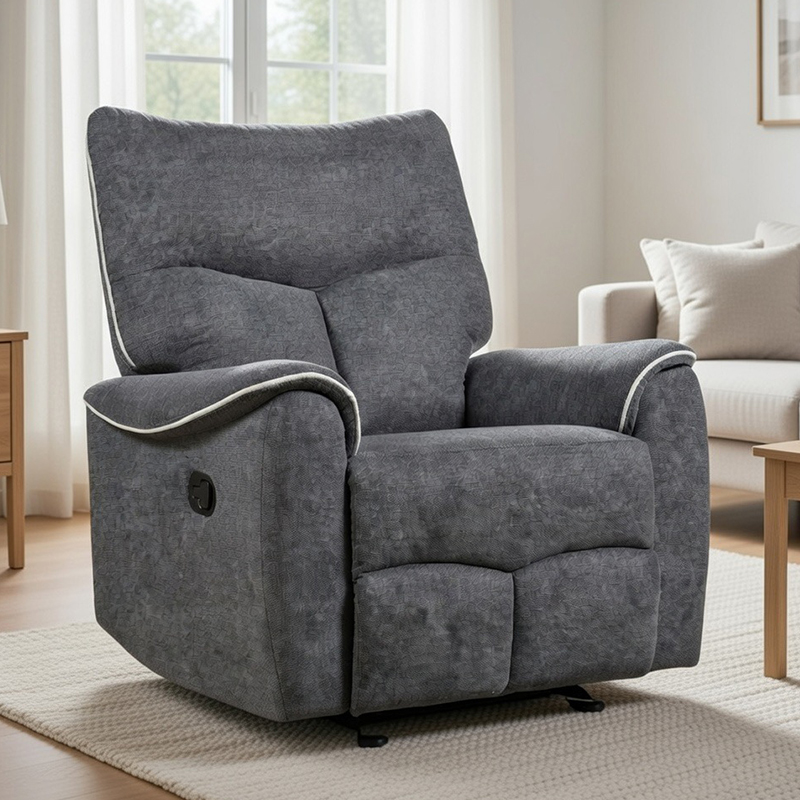
What Makes a Heavy Duty Power Lift Recliner Different
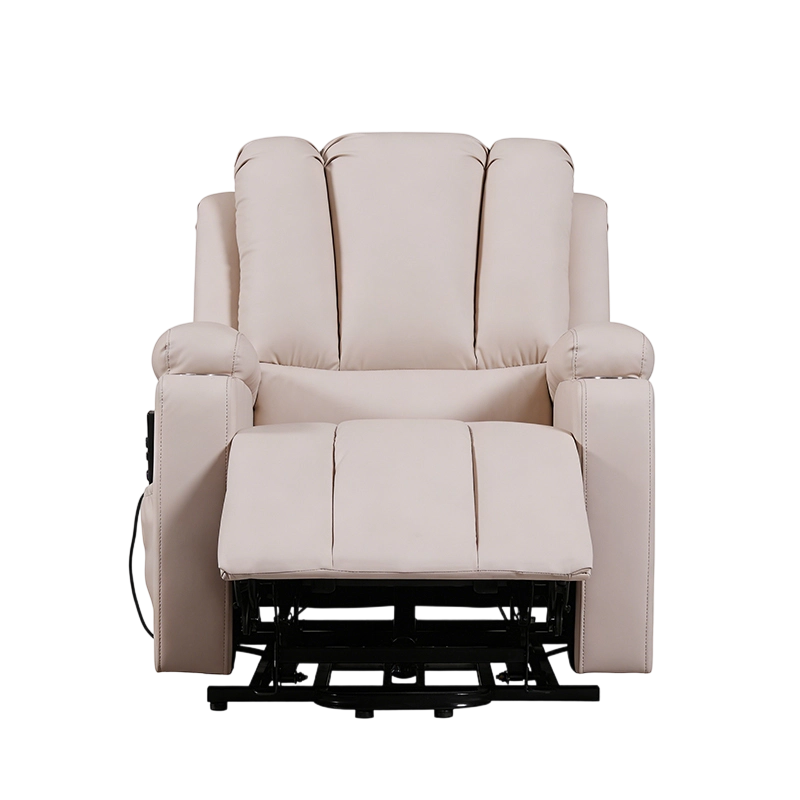
Heavy duty power lift recliners are purpose-engineered for users who exceed the weight capacity of standard models, which typically cap out at 250–300 lbs. Heavy duty variants are rated for capacities of 400 lbs, 500 lbs, or higher, and feature reinforced steel frames, wider seat widths (typically 22–26 inches), and higher-torque motors capable of sustaining the lift cycle under greater load.
Beyond weight capacity, heavy duty models differ from standard power lift recliners in several structural respects:
| Feature | Standard Power Lift Recliner | Heavy Duty Power Lift Recliner |
|---|---|---|
| Weight Capacity | 250–300 lbs | 375–600 lbs |
| Seat Width | 19–21 inches | 22–26 inches |
| Frame Material | Standard steel | Reinforced welded steel |
| Motor Rating | Standard torque | High-torque dual or single motor |
| Foam Density | Standard HR foam | High-density support foam |
Operating a heavy duty lift recliner at or near its rated maximum load will accelerate wear on the motor and linkage joints. As a general rule, select a model rated at least 50–75 lbs above the user's actual weight to extend mechanical longevity and reduce maintenance intervals.
How Electric Power Lift Recliner Chairs Work
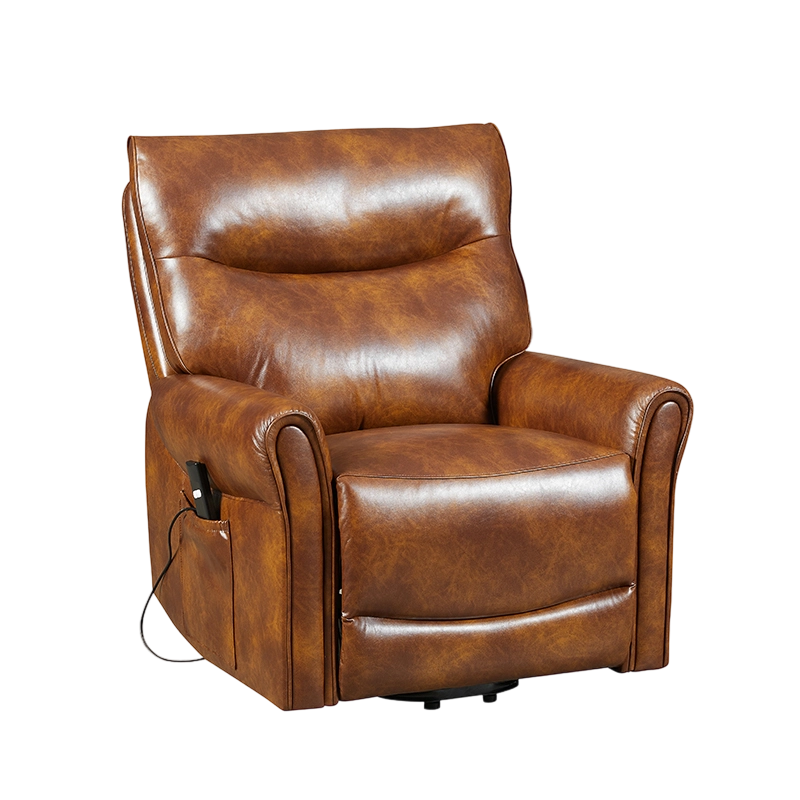
An electric power lift recliner chair uses one or two DC motors connected to a scissor-lift or parallelogram linkage beneath the seat. When the user presses the lift button on the wired or wireless handset, the motor drives the linkage to tilt the entire chair forward at an angle — typically between 10° and 20° — bringing the user to a near-standing position with minimal effort. The same mechanism reverses to lower the chair gently back to seated.
Single-motor models control the lift and recline functions through a unified linkage, meaning reclining the back automatically extends the footrest. Dual-motor models operate the backrest and footrest independently, giving users more precise positioning options — particularly useful for post-surgical recovery or managing edema, where leg elevation independent of back angle is clinically beneficial.
Most electric power lift recliners available today include the following features as standard:
- Battery backup — allows the lift function to operate during a power outage, preventing users from being stranded in a reclined position
- Infinite position locking — stops and holds the chair at any point along its range of motion
- Side pockets — for storing the handset, remote controls, or personal items
- USB charging ports — integrated into the handset cable or armrest panel
Noise output from the motor is a common purchase concern. Quality motors in name-brand models operate at under 45 dB — roughly equivalent to a quiet conversation. Noisy operation typically indicates a worn motor, insufficient lubrication, or an overloaded mechanism.
Choosing Electric Recliner Chairs With Lift: A Practical Buyer's Guide
The market for electric recliner chairs with lift has expanded significantly, with models now ranging from under $400 to over $3,000 depending on upholstery grade, motor quality, and added features such as heat and massage. Navigating this range requires prioritizing the factors that directly affect safety and long-term usability.
1. Fit the Chair to the User's Body Dimensions
Seat height, seat depth, and back height all need to match the user's body. For a proper fit: knees should bend at approximately 90° when seated, feet should rest flat on the floor (or footrest when extended), and the lumbar should make contact with the back cushion without forcing the user forward. Most manufacturers publish a recommended height range — typically 5'0"–6'2" for a standard model.
2. Verify the Actual Weight Capacity
Stated weight capacities on budget models are sometimes based on static load only, not the dynamic load of the lift cycle. Look for models where the rated capacity applies to the full motorized lift function, not just seated use. Certifications from UL, ETL, or equivalent testing bodies provide independent verification of this claim.
3. Evaluate Upholstery for the Use Context
For users with incontinence, perspiration sensitivity, or who will be using the chair for extended daily periods, genuine leather or high-grade PU leather is easier to clean and more resistant to moisture damage than fabric. Fabric upholstery, while typically softer and more breathable, requires more frequent cleaning and may trap odors over time in high-use environments.
4. Consider Wall Clearance Requirements
Standard power lift recliners require 12–18 inches of clearance from the wall to fully recline. Wall-hugger or zero-wall-clearance models achieve a full recline with only 3–6 inches of rear clearance by using a forward-sliding mechanism. This is a critical spec in smaller rooms or assisted living environments where furniture placement is constrained.
5. Assess the Warranty and After-Sale Support
Motor and frame warranties vary widely. A reliable manufacturer should offer a minimum of 1 year on the motor and 3–5 years on the frame. Verify whether the warranty covers in-home service or requires the user to ship the chair — a significant logistical burden for mobility-limited users. Spare parts availability and a domestic service network are equally important for long-term ownership.
Common Problems With Power Lift Recliners and How to Avoid Them
Even well-rated electric lift recliners encounter predictable issues when improperly selected or used. The most frequently reported problems across product categories include:
- Motor failure under load — most often caused by exceeding rated weight capacity or continuous-use cycling beyond the motor's duty cycle specification
- Handset or wiring faults — connector corrosion and cable fatigue near the armrest pivot point are common failure modes in chairs with intensive daily use
- Cushion compression — standard foam loses 15–25% of its original density within 12–18 months of daily use; high-density or memory foam seats degrade more slowly
- Linkage wear and noise — metal-on-metal joint contact areas benefit from periodic lubrication with silicone-based lubricant; petroleum-based products can degrade plastic bushings
- Chair walking on hard floors — the forward momentum of the lift cycle can cause lighter chairs to shift; rubber feet or an area rug beneath the chair eliminates this issue
Scheduling a brief inspection of the motor mount bolts, linkage joints, and handset cable every six months catches the majority of these issues before they result in complete functional failure.
LET'S TALK

Bai Shuiwan Industrial Park, Tian Huangping Town, Anji County, Huzhou City, Zhejiang Province, China
More About Us 
-
+86 18257273741
-
[email protected]
CONTACT US
Copyright © Anji Xuanbo Household Co., Ltd. All Rights Reserved.
Custom Modern Upholstered Sofa Manufacturers


