Focus on the manufacturing and export of functional sofas
-
 +86 18257273741
-
 [email protected]

 English
 Español
Industry News
 Home / News / Industry News / Leather Lift Recliner: Types, Features, and How to Choose the Right One
 Leather Lift Recliner: Types, Features, and How to Choose the Right One
 2026.05.14
 Industry News
Content
- 1 What Is a Leather Lift Recliner?
- 2 Who Benefits Most from a Leather Lift Recliner
- 3 Types of Lift Mechanisms: 2-Position, 3-Position, and Infinite
- 4 Leather Options: Full-Grain, Top-Grain, and Bonded
- 5 Key Features to Look for When Buying
- 6 Medicare, HSA, and FSA Coverage for Lift Recliners
- 7 Maintenance and Care for Leather Lift Recliners
What Is a Leather Lift Recliner?
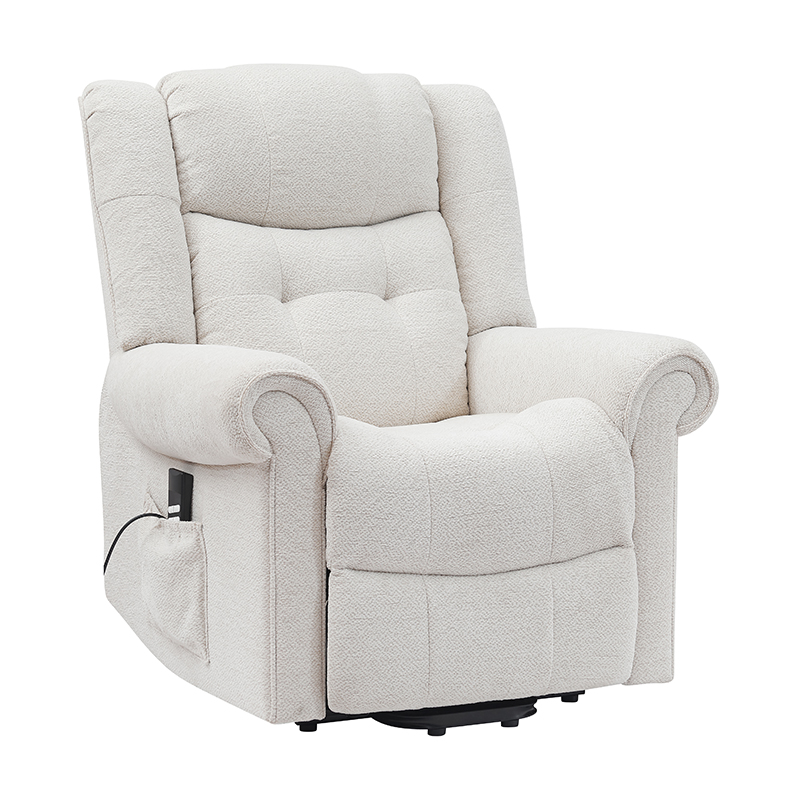
A leather lift recliner is a power-operated armchair upholstered in leather that combines two functions: a reclining backrest and footrest for relaxation, and a motorized lift mechanism that tilts the entire chair forward to help the user rise to a standing position with minimal effort. Unlike a standard recliner, the seat does not simply lean back — it also rises and angles forward on a base-mounted actuator, reducing the strain on knees, hips, and lower back that makes standing difficult for many people.
The leather upholstery distinguishes this category from fabric equivalents. Full-grain, top-grain, and bonded leather variants each offer a different balance of durability, softness, and price. Genuine top-grain leather, for example, resists spills and body oils better than most fabrics, wipes clean with a damp cloth, and develops a patina over years of use rather than pilling or fading. These properties make leather lift recliners a popular long-term investment for living rooms and home care settings alike.
Who Benefits Most from a Leather Lift Recliner
Lift recliners were originally designed as mobility aids, and their core users remain older adults and people recovering from surgery or managing chronic conditions. According to the CDC, more than 36 million falls occur among older adults in the United States each year, and the transition from seated to standing is one of the most common moments when balance is lost. A lift chair reduces that risk by controlling the angle and speed of the rise, keeping the user stable throughout.
Beyond fall prevention, leather lift recliners benefit:
- Post-surgical patients — Hip and knee replacement protocols typically restrict how far the joint can bend. A lift chair allows patients to sit and rise without exceeding those angle restrictions, supporting compliance with physical therapy guidelines.
- People with arthritis or Parkinson's disease — Reduced grip strength and unpredictable tremors make pushing up from a low seat hazardous. Motorized assistance removes the need for upper-body leverage entirely.
- Individuals with edema or poor circulation — Many lift recliner models offer a Zero-Gravity or Trendelenburg position that elevates the legs above heart level, encouraging venous return and reducing ankle and calf swelling.
- Caregivers — A lift chair reduces the physical demand on family members or home health aides who would otherwise assist with transfers multiple times a day.
Types of Lift Mechanisms: 2-Position, 3-Position, and Infinite
Not all leather lift recliners recline to the same degree. The mechanism type defines how far back the chair can go and which therapeutic positions are achievable.
| Type | Recline Range | Full Flat? | Best Use |
|---|---|---|---|
| 2-Position | Upright + partial recline (~45°) | No | Sitting, light napping |
| 3-Position | Upright, TV, full recline (~75°) | No | Everyday lounging |
| Infinite / Zero-Gravity | Any angle, including 180° | Yes | Sleeping, edema, post-surgery |
Infinite-position models use two independent motors — one for the backrest, one for the footrest — allowing each to be adjusted separately. This dual-motor design is more expensive but enables the chair to serve as a primary sleeping surface, which matters for users who cannot comfortably get in and out of bed. Single-motor 3-position chairs move the back and footrest in a fixed ratio and are generally sufficient for daytime use.
Leather Options: Full-Grain, Top-Grain, and Bonded
The leather grade determines long-term durability, feel, and maintenance requirements — three factors that matter significantly in a chair used multiple times daily.
- Full-grain leather retains the complete outer surface of the hide, including natural markings. It is the most durable grade, develops a rich patina, and is highly breathable. It is also the most expensive and typically found in premium lift recliner lines.
- Top-grain leather is sanded to remove surface imperfections and then finished with a protective coating. It is more uniform in appearance, slightly less breathable than full-grain, but easier to clean and more resistant to staining. Most mid-range leather lift recliners use top-grain leather on the seating surfaces, with split leather or match material on the sides and back.
- Bonded leather (also labeled "reconstituted leather") is made from shredded leather fibers bonded with polyurethane. It looks like leather initially but is prone to peeling and cracking within 2–5 years under regular use. For a lift recliner that may see 6–8 hours of daily use, bonded leather is generally not recommended as a long-term investment.
For users in warmer climates or those who run warm, leather-match upholstery — genuine leather on contact surfaces, vinyl on sides and back — offers a practical cost saving without sacrificing the tactile experience where it matters most.
Key Features to Look for When Buying
With dozens of models available at a wide price range — from under $500 to over $3,000 — narrowing the field requires evaluating specifications against the user's specific needs.
- Weight capacity — Standard lift recliners support 300–375 lbs. Heavy-duty and bariatric models extend capacity to 500–700 lbs and typically feature wider seats (22–28 inches across). Always verify the rated capacity against the user's weight with a comfortable margin.
- Seat height and depth — The seat height when upright should allow the user's feet to rest flat on the floor with hips at roughly 90 degrees. Seat depths typically range from 19 to 23 inches; petite users need shallower seats to avoid pressure behind the knees, while taller users need deeper ones for thigh support.
- Battery backup — A power outage should not leave the user trapped in a reclined position. Look for models with a battery backup port (usually a 9V connector) that allows the chair to return to upright even without mains power.
- Remote control design — Simple two-button or three-button wired remotes are easier to operate for users with arthritis or reduced fine motor control than multi-function wireless pads. Backlit buttons and large print are practical additions.
- Heat and massage — Many leather lift recliners include built-in lumbar heat and vibration massage. Heat can ease muscle tension and improve local circulation; massage motors vary widely in quality. These features add convenience but also complexity — verify the warranty covers motorized components.
- Wall clearance — Standard lift recliners require 12–18 inches of clearance from the wall to recline fully. Wall-hugger (space-saver) models slide the seat forward as the back reclines, reducing the required clearance to as little as 4–6 inches — a significant advantage in smaller rooms.
Medicare, HSA, and FSA Coverage for Lift Recliners
In the United States, lift chairs occupy an ambiguous space in healthcare coverage. Medicare Part B may cover the lift mechanism portion of a lift recliner — but not the chair itself — when a licensed physician certifies medical necessity for a patient with a severe neuromuscular disease or severe arthritis of the hip or knee. Coverage, when approved, is typically 80% of the Medicare-approved amount for the motor mechanism after the Part B deductible is met. The upholstery, frame, and cushioning are classified as personal convenience items and are excluded.
Health Savings Accounts (HSA) and Flexible Spending Accounts (FSA) can generally be used to purchase a lift recliner when accompanied by a Letter of Medical Necessity (LMN) from a physician. Policies vary by plan administrator, so confirm eligibility before purchase. Some retailers provide documentation assistance as part of the sales process.
Maintenance and Care for Leather Lift Recliners
A leather lift recliner maintained properly can last 10–15 years or more. The mechanical and upholstery components each have their own care requirements.
- Leather conditioning — Apply a pH-balanced leather conditioner every 6–12 months to prevent drying and cracking, particularly in low-humidity environments or where the chair receives direct sunlight. Avoid silicone-based products, which can soften leather excessively over time.
- Spill response — Blot (do not rub) liquid spills immediately with a clean, dry cloth. For stubborn stains, use a manufacturer-approved leather cleaner. Harsh solvents, bleach, or ammonia-based cleaners will strip protective coatings and accelerate cracking.
- Mechanical inspection — Periodically check that the power cord and remote cable are not pinched under the chair base during operation. Keep the area beneath and behind the chair clear so the lift mechanism moves freely. Lubricate pivot points with a dry lubricant (not oil-based, which attracts dust) if squeaking develops.
- Motor care — Never exceed the chair's rated weight capacity, as overloading is the leading cause of motor burnout. If the motor sounds strained or the chair moves more slowly than usual, stop using the lift function and contact the manufacturer before damage becomes irreparable.
LET'S TALK

Bai Shuiwan Industrial Park, Tian Huangping Town, Anji County, Huzhou City, Zhejiang Province, China
More About Us 
-
+86 18257273741
-
[email protected]
CONTACT US
Copyright © Anji Xuanbo Household Co., Ltd. All Rights Reserved.
Custom Modern Upholstered Sofa Manufacturers


