Focus on the manufacturing and export of functional sofas
-
 +86 18257273741
-
 [email protected]

 English
 Español
Industry News

Electric Recliner Corner Sofa: Buying Guide, Sizes & Features
 2026.05.09
 Industry News
Content
- 1 What Is an Electric Recliner Corner Sofa?
- 2 How the Electric Reclining Mechanism Works
- 3 Configuration Options: Choosing the Right Layout
- 4 Upholstery Materials: Leather, Faux Leather, and Fabric Compared
- 5 Frame and Suspension: What Determines Long-term Comfort
- 6 Buying Checklist: What to Verify Before Purchasing
What Is an Electric Recliner Corner Sofa?
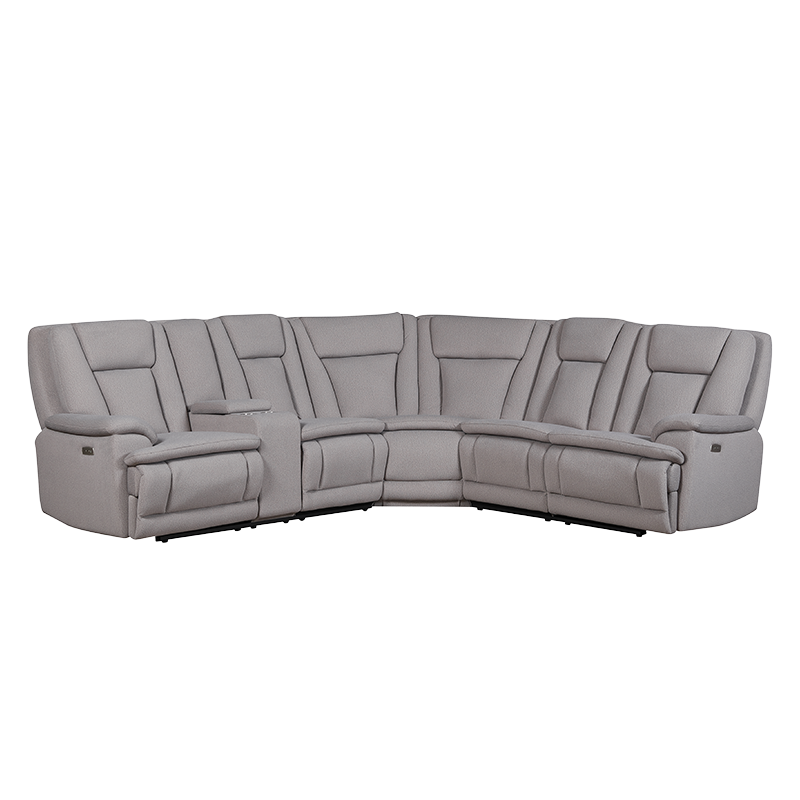
An electric recliner corner sofa combines the space-maximising L-shaped or U-shaped corner configuration with power-operated reclining seats. Rather than the manual push-back or pull-tab mechanism found on traditional recliners, each reclining seat is driven by a quiet electric motor—typically activated by a discreet side-panel button or a handset—that independently adjusts backrest angle and footrest extension to any position within its range of travel.
The result is a seating system that does two jobs at once: it fills a corner efficiently, seating four to seven people depending on configuration, while giving each occupant precise, effortless control over their own recline position without disturbing neighbours on the same sofa. This combination has made electric recliner corner sofas one of the fastest-growing categories in the upholstered furniture market across Europe and North America.
How the Electric Reclining Mechanism Works
Understanding the mechanics helps in comparing quality levels across products and identifying potential long-term reliability differences.
Motor and Drive Train
Most electric recliner sofas use a 24V DC linear actuator motor per reclining seat. The motor drives a lead screw that extends or retracts a push rod connected to the seat's reclining frame, moving backrest and leg rest in a coordinated arc. Quality actuators from manufacturers such as Linak or Dewert are rated for tens of thousands of cycles—well beyond a typical sofa's useful life—while budget alternatives using unbranded motors may show performance degradation within three to five years of daily use.
Single vs. Dual Motor Configurations
Entry-level electric recliners use a single motor that moves backrest and footrest together in a fixed ratio. Dual-motor systems drive the backrest and leg rest independently, allowing the occupant to sit upright with legs raised, recline fully with legs flat, or find any combination in between. For users with specific postural or comfort needs—including those recovering from surgery or managing chronic back pain—dual-motor independent adjustment is a meaningful functional difference, not a premium add-on.
Power Supply and Cable Management
Each reclining seat requires a mains power connection, typically via a transformer that converts 230V AC (or 120V in North America) to the low-voltage DC supply. Corner sofas with three or four reclining seats therefore require careful planning for cable routing and socket placement. Many contemporary designs integrate USB charging ports and occasionally wireless charging pads into the console units, consolidating power needs at a single point in the sofa's structure.
Configuration Options: Choosing the Right Layout
Electric recliner corner sofas are sold in modular or fixed configurations. Understanding the layout terminology prevents costly sizing mistakes:
| Configuration | Typical Seating | Approx. Footprint | Best Room Size |
|---|---|---|---|
| 3+2 Corner (L-shape) | 4–5 people | 270 × 200 cm | Medium lounge (16–25 m²) |
| 5-seater L-shape with chaise | 5–6 people | 300 × 220 cm | Large lounge (25–35 m²) |
| U-shape / Panoramic | 6–8 people | 350 × 300 cm+ | Open plan (35 m²+) |
| Modular (build-to-size) | Variable | Custom | Any room with power access |
One dimension that many buyers overlook is recline depth clearance. When fully reclined, the footrest extends forward and the backrest drops back, adding 25–40 cm to the sofa's effective depth. There must be adequate clearance behind the sofa—typically a minimum of 10–15 cm from the wall—and in front of it for the footrest travel. Measuring for a recliner corner sofa without accounting for recline depth is one of the most common and expensive purchasing mistakes.
Upholstery Materials: Leather, Faux Leather, and Fabric Compared
The upholstery choice on an electric recliner corner sofa deserves careful consideration because the reclining mechanism creates repeated flexing stress at the seat crease and footrest hinge points—areas where inferior materials show premature cracking or pilling before the rest of the sofa shows wear.
- Full-grain or top-grain leather is the most durable option for high-use recliners. It develops a patina with age, resists surface cracking at flex points, and is easily wiped clean. The trade-off is cost and the need for periodic conditioning to prevent drying and cracking in low-humidity environments.
- Bonded or split-grain leather is frequently marketed as leather at lower price points but contains only 10–20% genuine hide layered over a polyurethane backing. It is significantly less durable at flex points and commonly begins to peel within three to five years of regular use—a particular concern on recliner sofas where flexing is constant.
- PU and microfibre faux leathers have improved substantially in quality and now offer a viable alternative at mid-price points. Look for products rated to EN 13336 abrasion standards with a minimum 50,000 Martindale rub count for recliner applications.
- Performance fabrics (solution-dyed polyester, stain-treated weaves) offer the widest colour and texture range and excel in households with children or pets. Ensure any fabric specified for a recliner sofa carries a minimum 40,000 Martindale rub count; the repeated flexing at reclining points subjects upholstery to far more abrasion cycles than a standard static sofa.
Frame and Suspension: What Determines Long-term Comfort
The reclining mechanism often receives all the attention during a purchase decision, but the sofa's static comfort and long-term shape retention depend equally on frame construction and seat suspension.
Kiln-dried hardwood frames (beech, birch, or rubberwood) resist warping and provide stable fixing points for the motor mounts and reclining mechanisms. Frames constructed from green or low-grade timber will shrink, twist, and loosen joint connections within a few years, causing squeaks and eventual structural failure. Engineered wood components are acceptable in non-stress-bearing areas but should not be used at recliner pivot points or motor attachment brackets.
For seat suspension, sinuous (S-spring) systems are standard across the mid-market and provide adequate support when correctly tensioned. Eight-way hand-tied coil spring systems, found in premium sofas, offer superior load distribution and longer-term shape retention but add significant weight and cost. Regardless of spring type, foam density and ILD (Indentation Load Deflection) rating govern seated comfort more than any other single factor: seat cushions for everyday use should use HR (High Resilience) foam at a minimum density of 1.8 lb/ft³ (approximately 29 kg/m³) to resist permanent compression set over years of use.
Buying Checklist: What to Verify Before Purchasing
Given the combination of size, electrical components, and upholstery investment, an electric recliner corner sofa is a purchase that rewards methodical pre-purchase verification. The following points catch the majority of post-delivery regrets:
- Measure fully reclined dimensions, not just the footprint. Confirm clearance behind (wall gap), in front (footrest travel), and door/hallway access for delivery.
- Confirm which seats recline. On many corner configurations, the corner seat and one or more middle seats are static; only end seats recline. Verify the reclining seat count matches your expectations.
- Check the motor brand or specification. Branded actuators (Linak, Dewert, TiMOTION) indicate quality investment; unspecified "OEM motors" are a risk flag on a high-use item.
- Confirm upholstery Martindale rating in writing, not just a verbal assurance from sales staff.
- Review the warranty terms for the motor and mechanism separately from the frame and upholstery. A five-year frame warranty with a one-year motor warranty reveals where the manufacturer's confidence actually lies.
- Ask about spare parts availability. Replacement motors and handsets should be available for at least seven years from purchase date; confirm this before buying, especially from smaller or online-only retailers.
An electric recliner corner sofa that is correctly sized, properly specified, and sourced from a manufacturer with genuine after-sales support will deliver a decade or more of daily use—making the upfront diligence a genuinely worthwhile investment of time before purchase.
LET'S TALK

Bai Shuiwan Industrial Park, Tian Huangping Town, Anji County, Huzhou City, Zhejiang Province, China
More About Us 
-
+86 18257273741
-
[email protected]
CONTACT US
Copyright © Anji Xuanbo Household Co., Ltd. All Rights Reserved.
Custom Modern Upholstered Sofa Manufacturers


