Focus on the manufacturing and export of functional sofas
-
 +86 18257273741
-
 [email protected]

 English
 Español
Industry News

Manual Fabric Recliner Chairs: Frame, Fabric & Mechanism Guide
 2026.05.25
 Industry News
Content
- 1 Fabric Durability and Stain Resistance for Manual Fabric Recliner Chairs
- 2 Frame Construction and Weight Capacity in Manual Fabric Recliner Chairs
- 3 Manual Reclining Mechanism Options for Fabric Chairs
- 4 Seat Cushion Density and Long-Term Comfort
- 5 Maintenance and Cleaning Codes for Manual Fabric Recliner Chairs
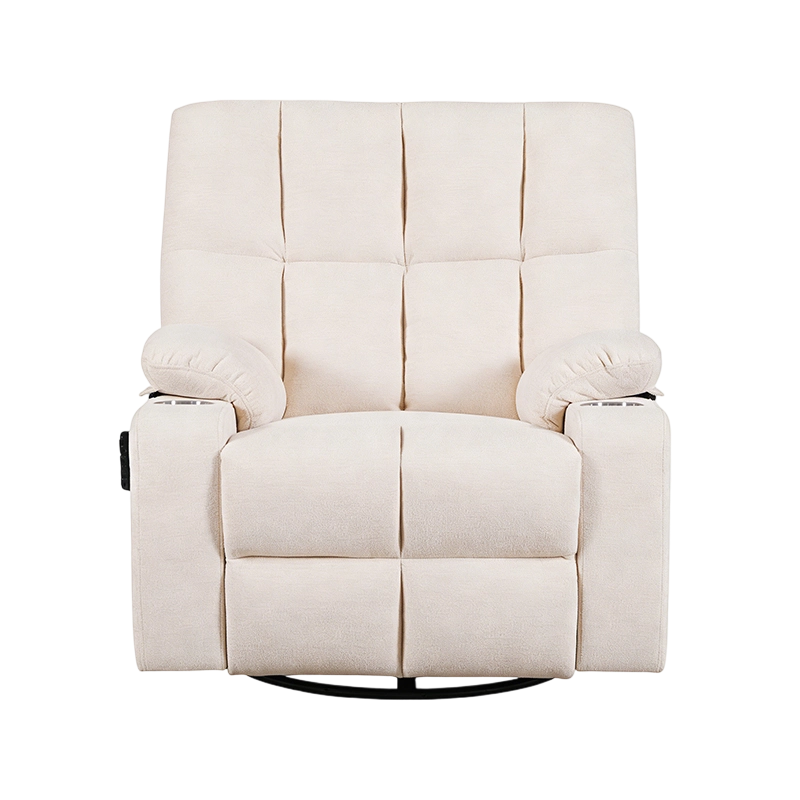
When investing in manual fabric recliner chairs, the combination of a kiln-dried hardwood frame, 1.8-pound density high-resiliency foam, and a push-back mechanism rated for 300 pounds provides the longest usable life. A polyester-blend fabric with a 50,000 double rub count resists pilling and fading for over 10 years of daily use, while the manual operation eliminates the motor and wiring that cause over 80 percent of power recliner service calls within the first five years.
Fabric Durability and Stain Resistance for Manual Fabric Recliner Chairs
The upholstery fabric is the most visible and frequently touched component of manual fabric recliner chairs. Its longevity is measured by the Wyzenbeek double rub test, which simulates years of abrasion. The table below categorizes common fabrics by their performance benchmarks.
| Fabric Type | Double Rub Rating | Stain Resistance | Best Use Case |
|---|---|---|---|
| Microfiber Polyester | 50,000 to 100,000 | Excellent, liquid beads | Homes with pets and children |
| Polyester-Cotton Blend | 25,000 to 40,000 | Moderate, may need treatment | Light-use living rooms |
| Linen-Look Polyester | 15,000 to 25,000 | Low, spot clean only | Adult-only formal spaces |
| Performance Velvet | 40,000 to 60,000 | High, water-repellent | High-touch family rooms |
A fabric rated below 15,000 double rubs is classified as decorative only and will show threadbare patches within 2 years on a recliner used daily. High-performance microfiber with a rub count above 50,000 retains its surface integrity even when exposed to direct window light for 1,500 hours, equivalent to 6 years of afternoon sun, making it the optimal cover for manual fabric recliner chairs placed near windows.
Frame Construction and Weight Capacity in Manual Fabric Recliner Chairs
The frame absorbs all the stress of the reclining motion and body weight. Kiln-dried hardwood such as birch or oak has a moisture content below 8 percent after drying, which prevents the warping and splitting that occurs in green wood frames when placed in a heated room. Plywood frames made from 7-layer laminated veneer lumber offer an acceptable alternative if the thickness is at least 15 mm at all structural joints.
A frame warranty of 10 years or lifetime signals confidence in the joinery. Corner blocks that are glued and screwed double the shear strength of each joint. A properly reinforced frame in manual fabric recliner chairs can support an occupant weight of 300 pounds through 25,000 recline cycles without developing a squeak. The sinuous springs used in these chairs are made from 8-gauge steel wire spaced 3 inches apart for a 300-pound capacity. For a 350-pound rating, the gauge increases to 7-gauge and the frame adds a fifth leg in the center front.
Manual Reclining Mechanism Options for Fabric Chairs
Two manual mechanism designs dominate manual fabric recliner chairs, each with a distinct service profile. The correct choice depends on the user's strength and room layout.
- Push-back mechanism operates by the user pressing their back against the backrest and extending the footrest with their legs. It uses a steel spring assembly rated for 80,000 cycles and requires a minimum body weight of approximately 110 pounds to engage smoothly.
- Lever-action mechanism uses a side-mounted handle that releases the footrest via a 1.5 mm braided steel cable. The lever requires a pull force of just 8 Newtons and is preferred by users with limited mobility. The cable should be inspected annually and replaced if any strand is broken, a repair costing under 20 USD.
The footrest extension in all manual fabric recliner chairs is designed to support 80 pounds of static load. Exceeding this by standing on the footrest bends the scissor linkage and requires a mechanism replacement costing approximately 150 USD in parts and labor.
Seat Cushion Density and Long-Term Comfort
The seat cushion directly controls how quickly the chair sags. High-resiliency polyurethane foam with a density of 1.8 pounds per cubic foot is the minimum specification for daily use in manual fabric recliner chairs. A cushion of this density, with a thickness of 5 inches, will lose less than 5 percent of its height after 10 years.
Low-density foam rated at 1.2 pounds per cubic foot compresses rapidly, losing 25 percent of its loft within the first 18 months. The best construction combines a 2.0-pound density core with a dacron fiber wrap to provide a crown that resists flattening. Always check the foam density tag when comparing manual fabric recliner chairs to ensure the seat will not bottom out against the frame after a few years.
Maintenance and Cleaning Codes for Manual Fabric Recliner Chairs
Regular fabric care extends the life of the recliner. The cleaning code tag sewn under the seat cushion dictates the only safe method. The codes and their steps are as follows.
- W code: Vacuum weekly. Spot clean spills immediately with a water-based upholstery shampoo. Blot, do not rub, to prevent fiber distortion on manual fabric recliner chairs.
- S code: Use only solvent-based cleaners. Dry cleaning solvent applied with a clean white cloth removes oil-based stains without leaving a water ring. Ventilate the room for 30 minutes after use.
- WS code: Either water or solvent cleaners are safe. A foam cleaner with a brush attachment lifts dirt from the fabric pile without overwetting the cushion core.
Microfiber covers with a W code can be steam cleaned once per year at a temperature of 80 degrees C. Steam kills dust mites and resets flattened fibers. Allow the recliner to dry for 6 hours before use to prevent moisture from reaching the springs and causing rust inside the frame of manual fabric recliner chairs.
LET'S TALK

Bai Shuiwan Industrial Park, Tian Huangping Town, Anji County, Huzhou City, Zhejiang Province, China
More About Us 
-
+86 18257273741
-
[email protected]
CONTACT US
Copyright © Anji Xuanbo Household Co., Ltd. All Rights Reserved.
Custom Modern Upholstered Sofa Manufacturers


