Focus on the manufacturing and export of functional sofas
-
 +86 18257273741
-
 [email protected]

 English
 Español
Industry News

Leather Corner Recliner Sofa: Buying Guide, Sizes & Care Tips
 2026.06.05
 Industry News
Content
- 1 What Is a Leather Corner Recliner Sofa?
- 2 Genuine Leather vs. Faux Leather: Which Is Right for a Corner Recliner?
- 3 How to Choose the Right Size Leather Corner Recliner Sofa
- 4 Manual vs. Power Recliner: Which Mechanism Is Better?
- 5 Styling a Leather Corner Recliner Sofa in Your Living Room
- 6 Caring for a Leather Corner Recliner Sofa Long-Term
What Is a Leather Corner Recliner Sofa?
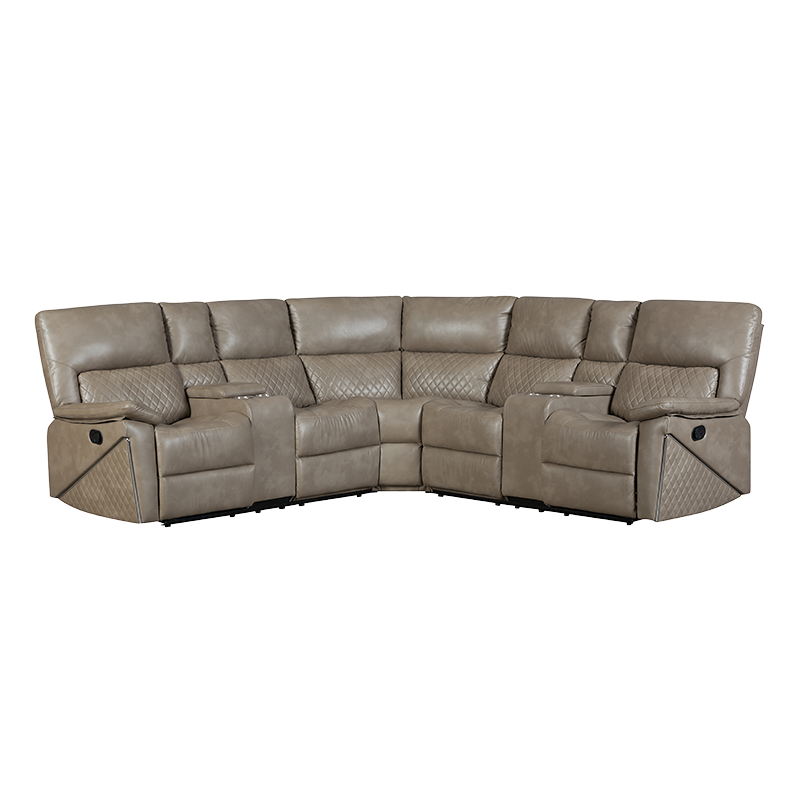
A leather corner recliner sofa combines three distinct furniture functions into a single unit: the space-efficient L-shaped corner configuration, premium leather upholstery, and built-in reclining mechanisms across multiple seats. The result is a sofa that anchors a room both visually and functionally — providing generous seating capacity, a cohesive aesthetic, and on-demand comfort adjustment without the need for separate recliners or additional seating pieces.
These sofas are available in two primary configurations. Left-hand facing (LHF) and right-hand facing (RHF) layouts describe which side the chaise or corner section extends toward when viewed from the front — a critical detail when planning placement in a specific room. Most models also offer a choice between manual recline mechanisms (pull-tab or push-back) and power recline via motor, with higher-end versions including USB charging ports and adjustable headrests.
Seating capacity typically ranges from 4 to 7 places depending on the sofa's overall length, corner section size, and whether individual seats are separated or bench-style. This makes leather corner recliner sofas one of the most practical choices for family living rooms, home cinemas, and open-plan spaces that demand both comfort and visual weight.
Genuine Leather vs. Faux Leather: Which Is Right for a Corner Recliner?
The leather category in corner recliner sofas covers a broader spectrum than the label suggests. Understanding the differences helps buyers match material to lifestyle rather than simply to budget.
| Leather Type | Key Characteristics | Best Suited For |
|---|---|---|
| Full-grain leather | Most durable; develops patina; breathable | Long-term investment, low-traffic rooms |
| Top-grain leather | Sanded surface; uniform finish; highly durable | Family use, frequent sitting |
| Split leather | Lower hide layer; less breathable; affordable | Secondary seating areas |
| PU / faux leather | Easy to clean; no conditioning needed; vegan | Households with pets or children |
| Bonded leather | Leather scraps + polyurethane; peels over time | Budget-only; short-term use |
For corner recliner sofas specifically, top-grain leather and high-grade PU leather are the most practical choices. The reclining mechanism creates repeated flex stress at seat joints and armrest seams — areas where full-grain leather's natural variation can lead to uneven wear, and where bonded leather is most likely to delaminate prematurely. A uniform, treated surface holds up better at these stress points over years of daily use.
How to Choose the Right Size Leather Corner Recliner Sofa
Sizing a corner recliner sofa requires more planning than a standard sofa because of three compounding factors: the L-shape footprint, the extended depth when reclined, and the clearance needed for the reclining mechanism to operate without obstruction.
Follow this sizing sequence before purchasing:
- Measure the room's longest wall and the adjacent wall where the corner section will sit. Allow a minimum of 50 cm between the sofa's outer edge and the nearest wall, doorway, or walkway.
- Account for reclining depth. Most recliner seats extend 40 to 55 cm forward when fully open. This space must be clear — no coffee tables, rugs with raised edges, or obstacles that would block the footrest.
- Check the corner section dimensions separately. The corner unit is typically 90 × 90 cm but can vary. This section often doesn't recline and functions as the anchor point — confirm it fits flush into your room corner without blocking sockets or radiators.
- Verify delivery access. Large leather corner recliner sofas are often delivered in sections but some models ship as a single frame. Measure doorways, hallways, and stairwells before ordering — the minimum recommended doorway clearance is 80 cm wide and 200 cm tall.
As a general guide, a room of 4 × 5 metres or larger comfortably accommodates a standard 5-seat leather corner recliner sofa without the space feeling overwhelmed. In smaller rooms, a compact 4-seat or modular configuration with a single recliner end is a more proportionate choice.
Manual vs. Power Recliner: Which Mechanism Is Better?
The reclining mechanism is the most mechanically complex part of a corner recliner sofa and the component most likely to require service over the sofa's lifespan. Choosing between manual and power recline involves weighing convenience, reliability, and cost.
Manual recliners use a side-mounted pull tab or a push-back mechanism where body weight drives the recline angle. They are mechanically simpler, require no power source, and are significantly easier and cheaper to repair. The limitation is that finding a comfortable position requires physical effort, and the range of recline angles is typically fixed to two or three positions rather than infinite adjustment.
Power recliners use an electric motor — typically 24V DC — to drive both the footrest and backrest independently. This allows precise positioning, full flat recline for sleeping, and effortless adjustment for elderly users or those with limited mobility. Premium power models add independent lumbar support, adjustable headrests, and integrated USB-A/USB-C charging ports in the armrests or side consoles.
The trade-off is that power recliners require proximity to a wall socket, add roughly 15 to 25% to the purchase price, and introduce motor failure as a long-term risk. Look for models with a minimum 3-year motor warranty and confirm whether replacement motors are available and serviceable independently of the frame.
Styling a Leather Corner Recliner Sofa in Your Living Room
A leather corner recliner sofa is a dominant piece — it sets the tonal direction of the room rather than adapting to it. Working with this characteristic rather than against it produces the most cohesive results.
- Classic black leather pairs naturally with dark wood floors, metal accents in brushed steel or matte black, and neutral walls in charcoal, warm grey, or deep navy. Avoid pairing with cool-toned blues or greens, which can make a black leather sofa feel heavy and cold.
- Brown and tan leather reads warmer and more transitional. It works equally well in contemporary interiors with concrete and linen textures and in more traditional rooms with oak furniture and patterned rugs. Cognac and saddle tones are particularly versatile across lighting conditions.
- Light grey or ivory leather creates a clean, modern aesthetic but requires more active maintenance in family environments. These tones work best in rooms with controlled natural light — south-facing rooms can cause ivory leather to yellow slightly over time if UV protection is insufficient.
- Throw cushions and blankets are the most effective tool for softening the structured look of a leather corner sofa. Textured fabrics — boucle, velvet, cable-knit — contrast well against the smooth leather surface and add visual warmth without competing with the sofa's silhouette.
Caring for a Leather Corner Recliner Sofa Long-Term
The leather surface and the reclining mechanism each require distinct maintenance routines. Neglecting either significantly shortens the sofa's useful life.
Leather care:
- Wipe down weekly with a dry or lightly dampened microfiber cloth to remove dust and body oils that degrade the surface finish over time.
- Apply a leather conditioner every 6 to 12 months for genuine leather — this prevents drying and cracking, particularly on seat surfaces and armrests that receive the most friction.
- For PU leather, skip conditioner and use a water-based protector spray annually instead. Avoid alcohol or solvent-based cleaners on any leather type.
- Keep the sofa at least 30 cm from radiators, fireplaces, and direct sunlight to prevent drying, fading, and surface cracking.
Mechanism care:
- Inspect the reclining mechanism annually for loose bolts, fraying cables (manual), or unusual motor sounds (power). Tighten any accessible hardware with the appropriate tool.
- Apply a small amount of silicone lubricant to metal pivot points and rails every 12 to 18 months to prevent squeaking and reduce wear on moving parts.
- Never force a recliner that meets resistance — this is the most common cause of mechanism damage. Check for obstructions beneath the seat before applying additional pressure.
With proper care, a well-constructed leather corner recliner sofa has a realistic lifespan of 10 to 15 years in a household setting — making the initial investment considerably more cost-effective than replacing lower-quality sofas every three to five years.
LET'S TALK

Bai Shuiwan Industrial Park, Tian Huangping Town, Anji County, Huzhou City, Zhejiang Province, China
More About Us 
-
+86 18257273741
-
[email protected]
CONTACT US
Copyright © Anji Xuanbo Household Co., Ltd. All Rights Reserved.
Custom Modern Upholstered Sofa Manufacturers


