Focus on the manufacturing and export of functional sofas
-
 +86 18257273741
-
 [email protected]

 English
 Español

Industry News
 Home / News / Industry News / Modular Corner Sofas vs Fixed L-Shape Sectionals: Packing and Layout Flexibility
Modular Corner Sofas vs Fixed L-Shape Sectionals: Packing and Layout Flexibility
 2026.11.23
 Industry News
Content
- 1 Modular Corner Sofas vs. Fixed L-Shape Sectionals: A Sourcing Perspective
- 2 Warehouse Packing: Why Modular Units Change the Logistics Math
- 3 Room Layout Flexibility: Corners, Doorways, and Changing Needs
- 4 Comparison Table: Modular Corner Sofas vs. Fixed L-Shape Sectionals
- 5 What to Consider When Sourcing Corner Sofas from a Factory
- 6 Frequently Asked Questions
- 6.0.1 Q1: What is the main difference between a modular corner sofa and a fixed L-shape sectional?
- 6.0.2 Q2: Is a modular corner sofa easier to pack into a warehouse or container?
- 6.0.3 Q3: Can a modular corner sofa be made as durable as a fixed L-shape sectional?
- 6.0.4 Q4: Which option is better for a buyer who wants to serve multiple room layouts?
- 7 Final Takeaway
Modular Corner Sofas vs. Fixed L-Shape Sectionals: A Sourcing Perspective
When a living room plan ends with an L-shaped footprint, furniture buyers usually choose between two seating systems: a modular corner sofa with independent segments or a fixed L-shape sectional that leaves the factory as a predetermined silhouette. The distinction affects more than style. It changes how the product is packed, how much warehouse floor it consumes, how many doorways it can pass through, and how easily a customer can reverse the layout after delivery.
For importers, wholesalers, and retail buyers, the practical difference sits in two areas: warehouse packing and room layouts.
Warehouse PackingRoom PlanningExport Sourcing
Warehouse Packing: Why Modular Units Change the Logistics Math
Fixed L-shape sectionals are often built around a rigid connection: a chaise or loveseat attaches to a three-seat frame with a metal clip or bracket. The final piece is wide, has at least one long side, and cannot be broken into smaller seating blocks without losing its intended structure. A modular corner sofa uses standalone blocks that connect with hooks, wedges, or lock plates. Because each block has its own arm, back, and seat, the factory can disassemble the sofa into more uniform cartons.
That structural difference creates a packing advantage. Modular sections can be placed into stacked, rectangular cartons with fewer air pockets. Fixed L-shape sectionals tend to ship as a few oversized or irregular packages, especially when the chaise and main seat arrive assembled or pre-joined. In a warehouse, packing density predicts storage cost and container utilization. Modular blocks also make it easier to distribute weight across a pallet, which simplifies forklift handling and reduces damaged-box claims.
From an export desk point of view, modular construction opens more shipment configurations. A supplier can arrange seating cubes and chaises so that the total volume stays compact, while a fixed L-shape is harder to rearrange once the production line sets its shape. This is one reason why modular corner sofas appear frequently in catalogues that target overseas buyers who consolidate orders from multiple factories.
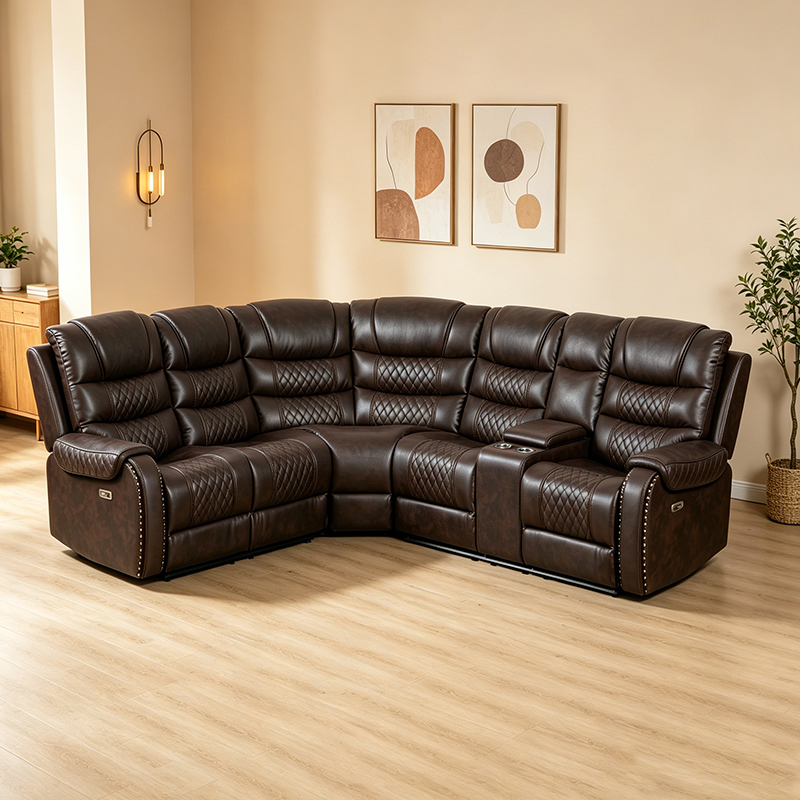 Six-Piece Power Reclining Sectional with Modular Wedge and StorageThis six-piece power reclining sectional uses a wedge module to create curved or corner layouts. Its modular segments allow flexible packing configurations, making it attractive for buyers consolidating shipments from multiple factories.View Product →
For a concrete example, a six-piece power reclining sectional set with modular segments can be loaded with interchangeable units, allowing the packing team to adjust orientation without changing the number of cartons. A fixed L-shape with the same seating area generally needs a more rigid carton design, leaving less room to optimize container space.
Room Layout Flexibility: Corners, Doorways, and Changing Needs
Fixed L-shape sectionals are engineered for one dominant layout: long side against a wall, shorter side wrapping a corner. That single orientation offers a clean, polished look and fewer seams. It works beautifully when the room has a clear architectural corner and the user does not expect to move the sofa often.
Modular corner sofas are the opposite. Because each block can be moved independently, a homeowner can switch the chaise from the left side to the right side, split the sofa into a straight arrangement, or create a wider U-shaped seating zone for a party. For apartment dwellers, the advantage becomes visible on moving day: a modular corner sofa can be carried through narrow corridors and doorways in smaller sections, while a fixed L-shape may require a stair lift, a window hoist, or a return to the warehouse.
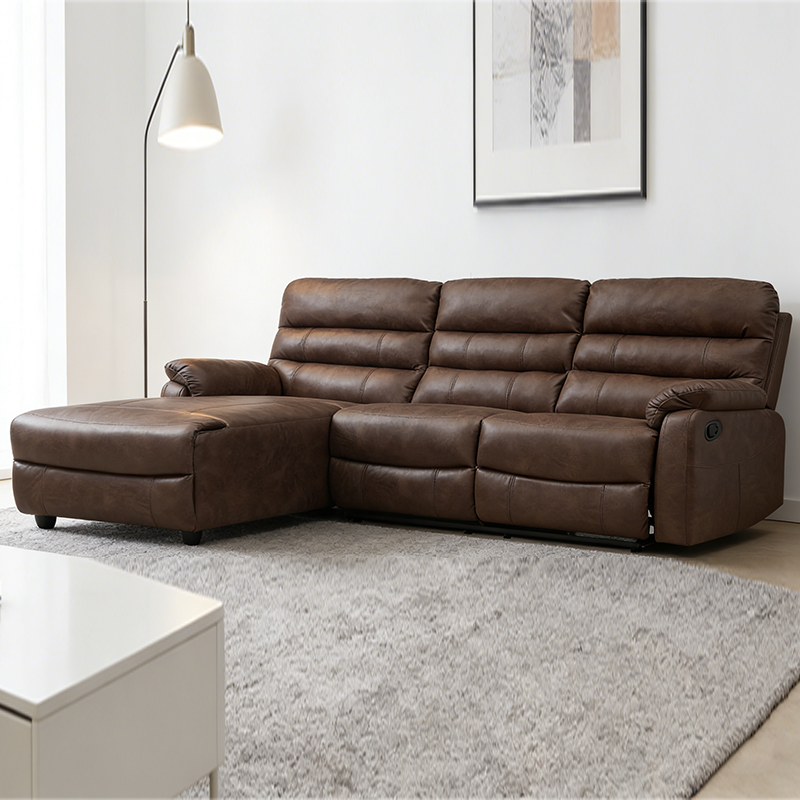 Three-Seat Modular Leather Sectional with Ottoman and Manual ReclineThis L-shaped modular sofa lets homeowners switch the chaise side or split sections, easing moves through narrow spaces. With a manual reclining seat and ottoman, it suits buyers wanting adaptable living room seating.View Product →
This flexibility also extends to product planning. Retail buyers who stock modular corner sofas can serve customers with different room orientations from a single SKU line. A fixed L-shape needs either left-facing and right-facing versions or a manufacturer that can swap the chaise during production. For an importer, modular inventory reduces the risk of being stuck with the wrong orientation after a customer measures their room.
Comparison Table: Modular Corner Sofas vs. Fixed L-Shape Sectionals
The table below summarizes the operational differences that matter to packing teams and interior layouts.
| Criterion | Modular Corner Sofa | Fixed L-Shape Sectional |
|---|---|---|
| Pack units | Multiple independent blocks | One joined frame or two fixed parts |
| Carton shape | Rectangular and stackable | Oversized and orientation-sensitive |
| Doorway access | Delivered piece by piece | Requires clearance room |
| Layout reversibility | Left or right chaise can be changed on site | Orientation fixed at the factory |
| Long-term flexibility | Can add or remove blocks | Limited to original configuration |
| Warehouse inventory risk | Lower risk with one SKU class | Higher risk from left/right-specific stock |
| Visual structure | Visible seams between blocks | Clean continuous profile |
| Best for | Apartments, rentals, frequent movers | Formal living rooms, stable floor plans |
What to Consider When Sourcing Corner Sofas from a Factory
For a manufacturer like Anji Xuanbo Household Co., Ltd., the modular-versus-fixed decision influences how a quotation is prepared. The company’s own production system keeps frame, foam, and fabric work under one roof, which allows buyers to adjust block size, chaise orientation, and upholstery without changing the core packaging model.
Three sourcing checkpoints
- Block dimensions: The width, depth, and height of each modular unit determine whether it fits standard container widths and passenger-door frames.
- Connection hardware: Metal hooks, plastic wedges, and hook-and-loop straps influence long-term stability. A fixed L-shape may be more rigid, but modular pieces with steel locking brackets can be just as stable.
- Finish quality: Visible seams make modular frame alignment more important. Ask for photos of the connecting edges before sampling.
Buyers who need more help comparing manual and electric motion layouts can read our guide to choosing a manual recliner corner sofa before placing an order.
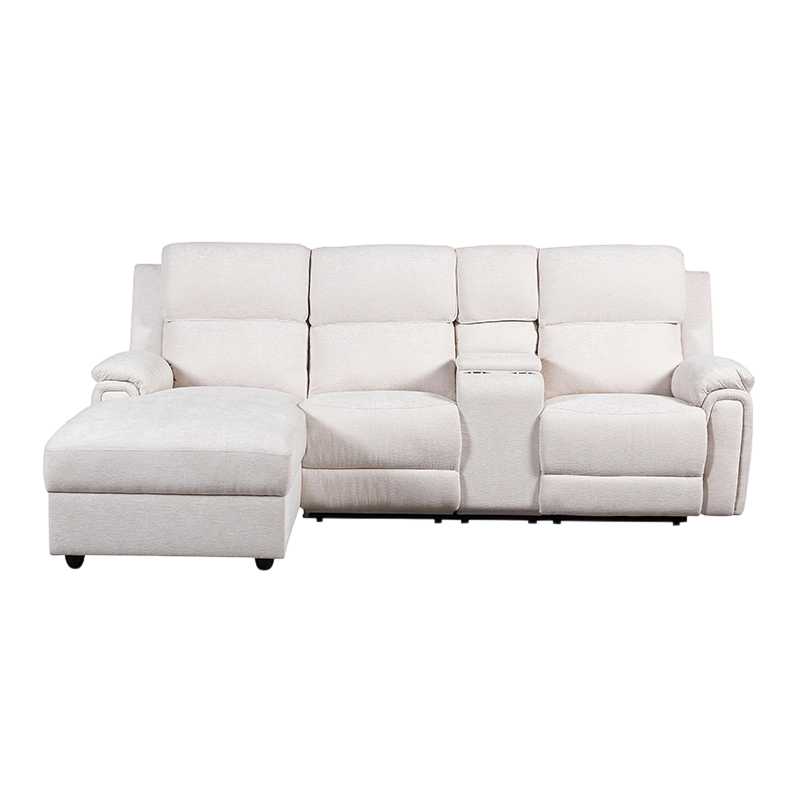
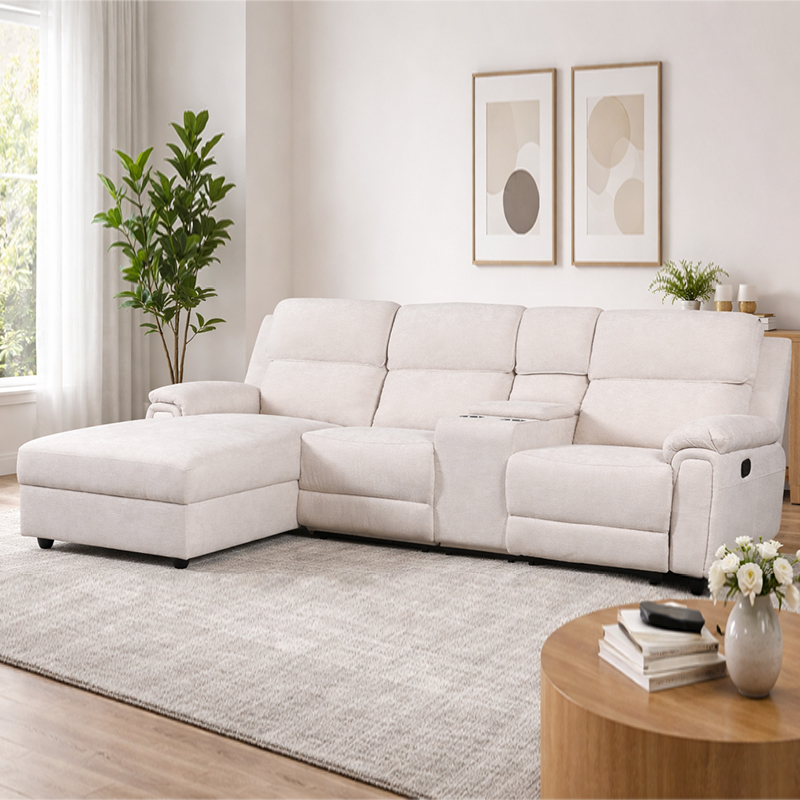 Compact Convertible L-Shaped Sectional with Right Chaise and OttomanThis small L-shaped sectional offers a manual reclining seat and extra-wide chaise in a compact footprint. Its convertible design ships in narrower cartons while delivering corner seating, ideal for apartments and studios.View Product →
For smaller rooms, a convertible L-shaped unit with a compact footprint proves that modularity is not limited to oversized sectionals. It can ship in narrower cartons while still giving the customer the same corner-wrapping seating geometry.
Frequently Asked Questions
Q1: What is the main difference between a modular corner sofa and a fixed L-shape sectional?
A: The main difference is how the pieces are connected. A modular corner sofa is made of independent blocks that can be separated, rearranged, or extended. A fixed L-shape sectional is built as one joined frame or two parts that create a single permanent orientation.
Q2: Is a modular corner sofa easier to pack into a warehouse or container?
A: Generally yes. Modular blocks are more uniform and can be stacked in rectangular cartons, which increases packing density. Fixed L-shape sectionals have larger irregular frames and require more fixed carton space, especially when their chaise orientation cannot be changed.
Q3: Can a modular corner sofa be made as durable as a fixed L-shape sectional?
A: Yes. Durability depends on the frame material, connector hardware, and foam density. Steel locking brackets and solid kiln-dried hardwood frames allow modular sections to feel as rigid as a fixed sectional after assembly.
Q4: Which option is better for a buyer who wants to serve multiple room layouts?
A: A modular corner sofa is usually better because one SKU can cover left-facing, right-facing, straight, and U-shaped layouts. A fixed L-shape is better when the customer expects a specific orientation and wants a clean continuous silhouette.
Final Takeaway
Choosing between modular corner sofas and fixed L-shape sectionals is not just an interior design decision. It is a logistics decision. Modular units offer shorter cartons, denser warehouse stacking, and easier room access. Fixed L-shape sectionals offer a seamless look and a simpler installation story.
For suppliers and buyers who work across borders, the modular corner sofa often reduces inventory risk and makes the product easier to move from warehouse to living room. But the right answer still depends on the shape of the customer’s room, the number of times they plan to move, and the packaging capacity available across the supply chain.
LET'S TALK

Bai Shuiwan Industrial Park, Tian Huangping Town, Anji County, Huzhou City, Zhejiang Province, China
More About Us 
-
+86 18257273741
-
[email protected]
CONTACT US
Copyright © Anji Xuanbo Household Co., Ltd. All Rights Reserved.
Custom Modern Upholstered Sofa Manufacturers


