Focus on the manufacturing and export of functional sofas
-
 +86 18257273741
-
 [email protected]

 English
 Español
Industry News
 Home / News / Industry News / Single vs. Dual Motor Electric Recliners: Backrest and Footrest Control Structure
 Single vs. Dual Motor Electric Recliners: Backrest and Footrest Control Structure
 2026.10.08
 Industry News
Content
- 1 Motor Architecture Sets the Rules for Backrest and Footrest Control
- 2 How a Single Motor Controls the Backrest and Footrest
- 3 How Dual Motors Separate Backrest and Footrest Control
- 4 Structural Comparison at a Glance
- 5 What the Structural Difference Means in Daily Use and Sourcing
- 6 Which Architecture Should a Buyer Choose
- 7 FAQ
- 7.0.1 Q1: In a single-motor recliner, do the backrest and footrest always move together?
- 7.0.2 Q2: Is a dual-motor recliner more likely to fail because it has two motors?
- 7.0.3 Q3: Does a dual-motor recliner automatically work as a lift chair?
- 7.0.4 Q4: What technical documents should a buyer request before ordering?
Motor Architecture Sets the Rules for Backrest and Footrest Control
When a buyer evaluates an electric recliner, the number of motors is often quoted on a spec sheet. The more important detail is what that motor count does to the mechanical structure. A single-motor unit couples the backrest to the footrest through one drive train; a dual-motor unit separates those two functions. That difference changes control behavior, seating posture, wiring, maintenance, and even the way the frame must be reinforced.
For wholesale buyers and private-label importers, understanding the structural difference between single-motor and dual-motor electric recliners is not only a technical exercise. It determines which models should be offered at an entry price point, how to support after-sales spare parts, and which recliners can honestly be marketed as independent-recline or zero-gravity units.
How a Single Motor Controls the Backrest and Footrest
One Motor, One Linked Motion Path
In a typical single-motor electric recliner, one gear motor drives a push rod through a high-torque gearbox. The push rod pushes a main pivot located below the seat. From that pivot, a set of steel links extends to the backrest frame and to the footrest frame. When the backrest pivots backward, the connecting link forces the footrest frame to swing outward and upward. On most designs, the two movements follow a fixed proportional path: a small change in the backrest angle creates a fixed change in the footrest angle. The user can stop the motor at any position, but cannot adjust the footrest without changing the backrest.
Trade-Offs in a Linked Structure
Linked control is simple to assemble. One motor, one transformer, and a shorter wire harness reduce both the bill of materials and the number of failure points during manufacturing. The frame can also be more compact because the linkage does most of the work. The trade-off is ergonomic: if a customer wants the footrest fully extended while the backrest remains upright, a linked mechanism can only offer a preset compromise.
How Dual Motors Separate Backrest and Footrest Control
Two Drives, Two Independent Torque Paths
A dual-motor recliner uses one motor for the backrest pivot and a second motor for the footrest extension. Each motor is mounted to a steel rail or bracket inside the frame and is connected to its own push rod. A small control box powers both drive units, and the hand pendant lets the user run them at the same time or separately. This means the backrest can be opened to a relaxing angle while the footrest is only slightly lifted, or the footrest can be raised fully while the backrest stays upright.
This independent motion path is why dual-motor chairs can enter a tilt-in-space type position more easily. Because the seat plane and lower leg zone are no longer locked to a mechanical ratio, the backrest angle can be opened with the front edge of the seat staying stable, reducing the feeling of being pushed forward.
What Changes in the Frame and Wiring Structure
Adding a second actuator creates structural demands. The side panel and seat-base rail need steel brackets at two dedicated mounting points. The cable harness must be routed on both sides of the frame without contacting moving links. Limit switches or position sensors are placed independently for each motion path to protect the end stops. This is why a dual-motor frame is generally heavier than a single-motor model with the same silhouette. It also requires the manufacturer to recalculate torque distribution at each pivot, not simply to bolt an extra motor onto an existing frame.
Structural Comparison at a Glance
The following table summarizes how the drivetrain structure changes backrest and footrest control.
| Aspect | Single Motor Architecture | Dual Motor Architecture |
|---|---|---|
| Drive chain | One motor, one push rod | Two motors, two push rods |
| Backrest control | Linked to footrest motion | Independent angle adjustment |
| Footrest control | Moves in fixed ratio | Independent movement |
| Mechanical linkage | Rod link between parts | Separate torque paths |
| Frame requirement | Compact bracket | Reinforced dual mounting points |
| Typical use | Entry-level power seating | Comfort and lift-oriented models |
What the Structural Difference Means in Daily Use and Sourcing
Independent Control Changes the Sitting Posture
In a living-room scenario, the most obvious difference is the ability to create a comfortable TV posture. With dual motors, the user can recline the backrest while fully raising the footrest at the same time, without over-pushing the lower back. A single-motor unit usually produces a predefined curve, and the user has to accept the ratio selected by the linkage.
For an elderly user, independent backrest and footrest control helps caregivers position the body before the lift function starts. Lift chairs rely on long-stroke actuators and higher push force; therefore, the presence of two motors does not automatically make a model a lift chair. The frame structure and actuator stroke must be designed for that function.
Sourcing Factors Driven by Structure
From a wholesale perspective, structural differences influence quality control and spare-parts management. A single-motor recliner has fewer electrical parts and is easier to approve in a fast program. A dual-motor recliner gives more sales features, but the buyer should request actuator specifications, limit-switch type, wiring layout documentation, and cycle-test records before tooling a large order.
Independent Motion Backrest and footrest can be moved in separate arcs.
Torque Paths Two actuators produce two load routes through the frame.
Service Access More cable components require clear access openings.
In our electric recliner range, models with a remote control are frequently evaluated by importers who want a wider motion envelope.
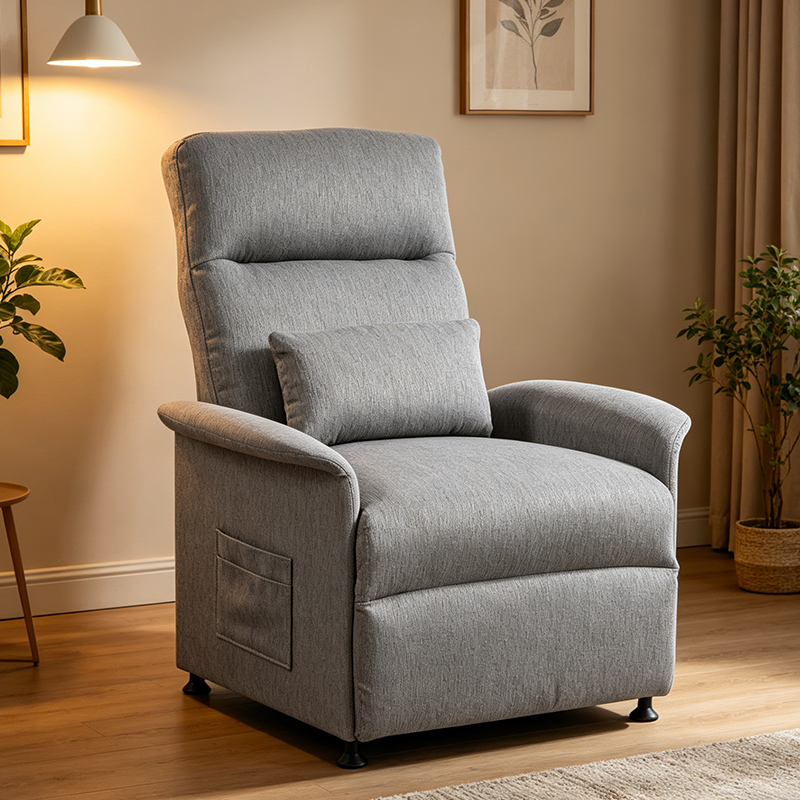 Electric Recliner Chair with Remote Control in Dark BlueThis power recliner offers effortless adjustment via a handheld remote, smoothly moving from 90° upright to 150° reclined. With high-density sponge and cushioned armrests, it suits importers seeking a reliable, comfortable motion chair.View Product →
For elderly-focused programs, extra-wide power lift chairs are usually built around high-torque actuation and a larger bearing surface under the seat.
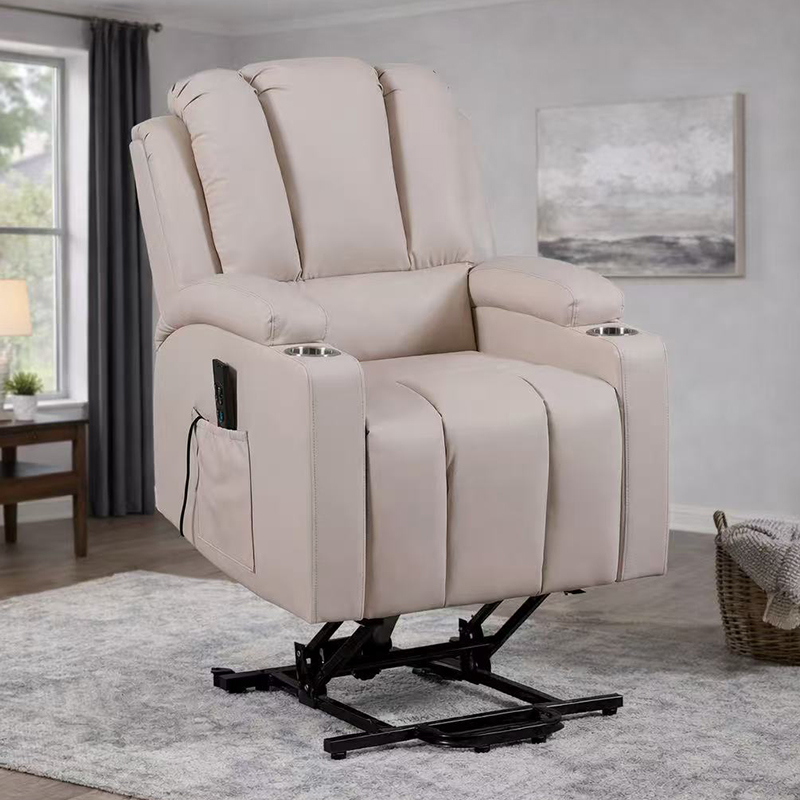 Extra Wide Power Lift Recliner for Elderly with Leather UpholsteryDesigned for elderly users or those with mobility challenges, this lift chair features a silent motor, infinite reclining positions, and a wired controller in a side pocket. Its solid metal frame and thick padding provide stable, supportive comfort.View Product →
Which Architecture Should a Buyer Choose
For entry-level wholesale markets, single-motor electric recliners keep the landed cost lower and simplify after-sales inventory. If the target customer mainly uses the chair for occasional TV viewing and afternoon naps, the linked motion path is a practical choice.
For premium lines, dual-motor architecture supports clearer selling points: independent back angle, independent footrest, and compatibility with zero-gravity or TV positions. These models also justify higher retail prices and offer more room for customization, as the buyer can specify different motor strokes and control-box positions.
A fuller comparison of manual, single-motor, and lift-chair drive mechanisms is available in our guide to recliner drive types.
When you plan a container order, share the target frame size, expected actuator stroke, and required safety tests with the factory. Located in Anji and supported by its own wood-frame and sponge-processing workshops, the manufacturing plant is set up to build a controlled structural system for electric recliners. You can contact the Anji Xuanbo export team directly to discuss your mechanical specification.
FAQ
Q1: In a single-motor recliner, do the backrest and footrest always move together?
In a linked single-motor mechanism, yes. The backrest pivot and the footrest frame share the same drive train, so changing the backrest angle also changes the leg zone. The ratio is defined by the linkage geometry.
Q2: Is a dual-motor recliner more likely to fail because it has two motors?
Failure risk is not higher simply because there are two motors. Quality depends on actuator rating, limit switches, and assembly discipline. A dual-motor frame requires more care with wiring and brackets, but good manufacturing prevents most problems.
Q3: Does a dual-motor recliner automatically work as a lift chair?
No. A lift chair needs a longer actuator stroke, higher push force, and a reinforced base. The structural and electrical designs are different, so the motor count alone does not determine lift capability.
Q4: What technical documents should a buyer request before ordering?
Request actuator specifications, limit-switch type, cycle-test records, and a drawing that shows motor bracket positions and wire routing. These documents reveal how carefully the frame and drive train were engineered.
LET'S TALK

Bai Shuiwan Industrial Park, Tian Huangping Town, Anji County, Huzhou City, Zhejiang Province, China
More About Us 
-
+86 18257273741
-
[email protected]
CONTACT US
Copyright © Anji Xuanbo Household Co., Ltd. All Rights Reserved.
Custom Modern Upholstered Sofa Manufacturers


