Focus on the manufacturing and export of functional sofas
-
 +86 18257273741
-
 [email protected]

 English
 Español
Industry News

What Is a Manual Recliner Chair? Benefits, Choice & Cleaning Guide
 2026.07.21
 Industry News
Content
- 1 How Does a Manual Recliner Chair Work?
- 2 What Are the Benefits of a Fabric Recliner Chair?
- 3 What Is the Difference Between Manual and Power Recliners?
- 4 How to Choose a Fabric Recliner Chair and What to Look For When Buying
- 5 How to Assemble a Recliner Chair
- 6 How to Clean a Fabric Recliner Chair
- 7 How to Maintain a Recliner Chair and How Long It Lasts
A manual recliner chair is a seat that leans back and raises a footrest using your body weight and a lever or push-back mechanism, not a motor. It offers the same deep relaxation as a powered version, but with fewer components that can fail and no need for a nearby electrical outlet. For anyone who wants a dependable spot to read, nap, or watch television without adding to their energy bill, understanding exactly what is a manual recliner chair and how to select, clean, and maintain one is a practical investment that pays off in comfort for well over a decade.
How Does a Manual Recliner Chair Work?
The mechanism that answers how does a manual recliner chair work is elegantly mechanical. Inside the frame, a system of heavy‑gauge springs and a ratcheting hinge controls the backrest angle and footrest extension. When you pull a side‑mounted lever or push against the backrest — depending on the model — a locking bar disengages, allowing the back to tilt and the footrest to swing up. Releasing the lever or returning to an upright position re‑engages the lock, holding the chair firmly in the chosen recline angle.
There are two dominant manual drive systems. The classic cable‑and‑handle design uses a lever that pulls a steel cable to release the seat lock, and the user’s body weight provides the motion. The push‑back design requires no lever at all — you simply press your shoulders into the backrest and push your heels down to extend the footrest. Both designs rely on a metal frame with pivot points that are typically rated for 20,000 to 50,000 cycles before any noticeable wear appears. Because no motor or control board is involved, the average manual recliner contains roughly 60% fewer moving parts than a comparable power recliner, which directly contributes to a longer trouble‑free lifespan.
What Are the Benefits of a Fabric Recliner Chair?
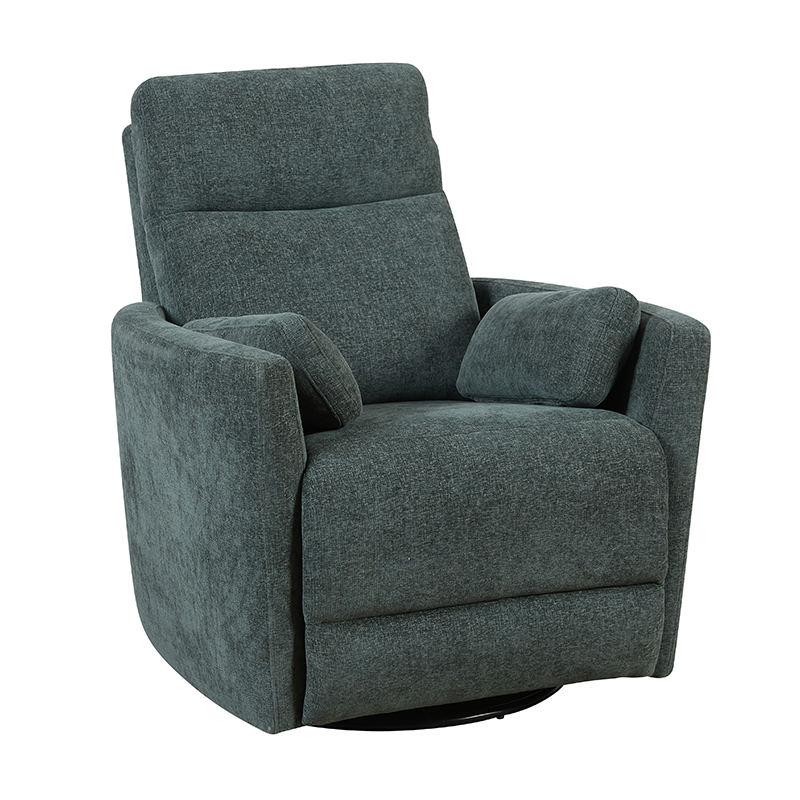
Choosing fabric upholstery over leather goes well beyond a softer initial touch. The benefits of a fabric recliner chair include breathability, year‑round comfort, a wider range of colors, and easier repair. Fabric does not become sticky in summer or icy cold in winter, which matters when you plan to spend multiple hours sitting. A tightly woven microfiber or performance fabric can resist spills and pet claws nearly as well as leather, while costing 25–40% less for the same recliner model.
Other practical advantages include:
- Grip: Fabric prevents sliding forward when the chair is semi‑reclined, helping maintain proper lumbar support without the need to readjust.
- Noise: Unlike leather, fabric does not creak or squeak as you shift position, which is especially noticeable in a quiet living room.
- Customization: Fabric recliners are available in hundreds of weaves, patterns, and colorfast shades, allowing an exact match to existing décor without needing to reupholster.
- Skin sensitivity: People with skin conditions or sensitivity to cold surfaces often find fabric much more comfortable for prolonged contact.
When these benefits are combined with a manual mechanism, the result is a chair that delivers core functionality without the cost and complexity premium of powered alternatives. Independent product reviews consistently rate manual fabric recliners higher for reliability precisely because there is less to go wrong.
What Is the Difference Between Manual and Power Recliners?
The difference between manual and power recliners comes down to operation, positioning precision, and dependency on electricity. The table below summarizes the core distinctions to help you decide.
| Feature | Manual Recliner | Power Recliner |
|---|---|---|
| Operation | Body weight and a lever or push‑back | Electric motor controlled by buttons |
| Power required | None | Wall outlet or battery pack |
| Position adjustability | 2–3 fixed positions, or infinite with certain push‑back designs | Infinite positions, often with memory settings |
| Weight (chair) | Lighter — typically 30–45 kg | Heavier — often 45–70 kg due to motor and frame |
| Repair complexity | Simple — spring or cable replacement | Moderate to complex — motor, wiring, control board |
| Price range | Generally 20–50% lower | Higher upfront cost and potential electricity use |
A manual recliner requires some physical strength to operate, particularly to close the footrest against spring tension. For individuals with limited mobility or chronic pain, this effort can be challenging, and a power recliner with a lift function may be medically indicated. For everyone else, the manual vs power recliners debate tilts in favor of manual for its simplicity, lower cost, and independence from power — a serious consideration during blackouts or when the chair is placed far from a wall socket.
How to Choose a Fabric Recliner Chair and What to Look For When Buying
Knowing how to choose a fabric recliner chair means evaluating the frame, mechanism, fabric grade, and cushion density — not just the color. The most critical things to check when asking what to look for when buying a recliner chair are summarised below:
- Frame material: Hardwood frames — particularly kiln‑dried oak or birch — resist warping and cracking. Avoid chairs with frames made primarily of particle board or low‑density plywood; they rarely survive a move.
- Mechanism type: The mechanism should operate smoothly without sticking. Look for steel springs and reinforced pivot points that have been tested to 25,000 cycles or more, which equates to approximately 15 years of daily use.
- Fabric grade and rub count: For a fabric recliner chair, the upholstery’s durability is measured in double rubs. A rating of 15,000–25,000 is acceptable for light use; for a daily‑use family chair, insist on 30,000–50,000 double rubs or higher.
- Seat cushion density: High‑resilience foam with a density of 2.0–2.5 pounds per cubic foot provides firm support that does not bottom out within a few years. Avoid low‑density foams under 1.5 lb/ft³; they lose their shape rapidly.
- Recline tension adjustment: Many quality manual recliners allow you to adjust the backrest tension to match your body weight. A chair that is too stiff for a lightweight user, or too loose for a heavier person, will be uncomfortable and can damage the mechanism.
- Dimensions and fit: Seat depth should allow 5–8 cm of space between the back of your knee and the seat edge. The seat width should leave at least 5 cm on each side. A chair that is too large causes slouching; too small causes pressure points.
It is worth spending a full 10–15 minutes sitting in any floor model in the exact position you plan to use at home. Bring a book or use your phone to simulate typical use, and stand up and sit down multiple times. If the chair feels even slightly uncomfortable during this test, that minor annoyance will likely become a significant regret after the first month of ownership.
How to Assemble a Recliner Chair
Understanding how to assemble a recliner chair prevents damage during setup and ensures the mechanism operates correctly from day one. Most manual recliners ship with the back detached from the seat base to fit in a manageable box. The assembly process, typically completed in 20–30 minutes by one person, follows these steps:
- Unpack and protect: Remove all packaging and lay the seat base on its side on a soft blanket. Check that all bolts, washers, and the lever handle are present using the included parts list.
- Attach the backrest: Slide the backrest brackets into the receiver channels on the seat base. Push down firmly until the locking tabs click into place, then install the retaining bolts. Do not fully tighten until both sides are started.
- Install the lever: If the lever ships separately, thread it into the mechanism port and secure the retaining screw. Operate the lever a few times to confirm the cable moves freely.
- Tighten all hardware: Use the included tool to torque all bolts to a snug, metal‑to‑metal fit — overtightening can strip wood threads. A typical bolt torque on a recliner frame is around 12–15 Nm.
- Test the mechanism: With the chair upright and no one sitting in it, recline and return several times to verify smooth motion and proper footrest extension.
The most common assembly mistake is forcing the backrest onto the base without proper alignment, which can bend the metal brackets. If the back does not slide in easily, check that the receiver channels are clear of packaging debris and that both sides are entering simultaneously. Once assembled, move the recliner to its final position before testing extensively to avoid scratching the floor.
How to Clean a Fabric Recliner Chair
Regular cleaning is essential to preserving both appearance and hygiene. The approach to how to clean a fabric recliner chair depends on the fabric’s cleaning code, which is printed on the tag beneath the seat or on the manufacturer’s label. That code determines safe cleaning agents:
- W: Water‑based cleaners only. Use a mild upholstery shampoo diluted with water, apply with a soft brush, and blot dry.
- S: Solvent‑based cleaners only. Water can stain or shrink the fabric. Use a dry‑cleaning solvent applied to a clean white cloth.
- WS or SW: Both water‑based and solvent‑based cleaners are safe.
- X: Vacuum only. No liquid cleaning agents at all.
For routine care, vacuum the entire surface with an upholstery attachment every two weeks, paying special attention to crevices where crumbs and dust accumulate. For spot cleaning, blot spills immediately with a clean, dry microfiber cloth — never rub, as rubbing pushes the liquid deeper into the fibers. Apply the appropriate cleaner to a cloth, not directly onto the fabric, and work from the outside of the stain inward to prevent spreading. After cleaning, allow the fabric to air‑dry completely before use. A fabric recliner cleaned according to its code and vacuumed regularly can remain stain‑free and odor‑free for its entire service life.
How to Maintain a Recliner Chair and How Long It Lasts
A well‑executed routine that covers how to maintain a recliner chair can add years to its life. The mechanical and structural elements require periodic attention:
- Lubricate moving parts: Apply a dry PTFE or silicone lubricant to pivot points and the reclining mechanism every 6 months. Avoid oil‑based lubricants, which attract dust and form a sticky residue.
- Tighten hardware: Check all visible bolts and screws every 3–4 months. The repeated motion of reclining can gradually loosen fasteners, particularly the backrest bolts.
- Protect the fabric: Apply a fabric protector spray annually if the material accepts it, and keep the chair out of direct sunlight to prevent UV fading. Even colorfast fabrics will fade over time if placed in front of an unshaded window.
- Rotate cushions: If the back or seat cushions are removable, flip and rotate them monthly to promote even wear.
When properly cared for, how long does a fabric recliner chair last is largely a function of initial quality and daily usage. A recliner with a hardwood frame, a high‑rub‑count fabric, and a mechanism rated for heavy use can comfortably reach 15 to 20 years of daily service. Chairs built with engineered wood frames and mid‑grade fabric typically last 7–10 years before the cushion loses support or the mechanism becomes noticeably loose. The most common end‑of‑life indicator is not frame breakage but seat foam that no longer recovers its shape — an issue that can sometimes be corrected by replacing the foam insert rather than the whole chair.
LET'S TALK

Bai Shuiwan Industrial Park, Tian Huangping Town, Anji County, Huzhou City, Zhejiang Province, China
More About Us 
-
+86 18257273741
-
[email protected]
CONTACT US
Copyright © Anji Xuanbo Household Co., Ltd. All Rights Reserved.
Custom Modern Upholstered Sofa Manufacturers


