Focus on the manufacturing and export of functional sofas
-
 +86 18257273741
-
 [email protected]

 English
 Español
Industry News

Manual vs Power Recliner: Fabric vs Leather, Cleaning & Sizing Guide
 2026.07.28
 Industry News
Content
- 1 Manual vs Power Recliner Chair: Mechanism, Cost, and Reliability
- 2 Fabric vs Leather Recliner Chair: Touch, Temperature, and Durability
- 3 Are Fabric Recliners Easy to Clean?
- 4 Are Recliner Chairs Good for Your Back?
- 5 Why Choose a Fabric Recliner Chair?
- 6 What Size Recliner Chair Do I Need and How Much Space Is Required?
- 7 How to Choose the Right Recliner for Your Living Room
- 8 What Type of Recliner Chair Is Most Comfortable?
Choosing the right recliner chair is a decision that affects daily comfort, living room aesthetics, and even spinal health for years. The two most fundamental choices — manual vs power recliner chair and fabric vs leather recliner chair — determine how you operate the chair and how it feels against your skin. Beyond materials and mechanisms, you need to confirm what size recliner chair do I need and how much space do you need for a recliner chair so the piece fits both your body and your room. This article answers all those questions, with concrete data and practical tips, so you can confidently select a chair that matches your lifestyle, décor, and need for genuine rest.
Manual vs Power Recliner Chair: Mechanism, Cost, and Reliability
The manual vs power recliner chair comparison starts with how you make the chair move. A manual recliner relies on your body weight and a lever or push‑back mechanism to extend the footrest and tilt the back. A power recliner uses an electric motor, controlled by buttons, to smoothly adjust the position. The trade‑offs are real and measurable, not just a matter of preference.
| Aspect | Manual Recliner | Power Recliner |
|---|---|---|
| Operation | Lever pull or body push; no electricity needed | Button‑controlled motor; requires wall outlet |
| Position control | Usually 2–3 locked positions; some infinite push‑back | Infinite, precise adjustment; often with memory settings |
| Physical effort | Moderate leg and back strength needed | None — suitable for limited mobility |
| Repair complexity | Simple mechanical parts: spring, cable, hinge | Motor, wiring, control board; often needs technician |
| Price range | Generally 20–40% lower | Higher upfront and potential repair costs |
Because a manual mechanism contains approximately 60% fewer components than a powered one, it tends to outlast motors and control boards. A well‑built manual recliner can cycle 25,000–50,000 times before any play appears, equivalent to over 20 years of daily use. Power recliners offer undeniable convenience — especially lift‑assist models for the elderly — but they tie you to an electrical outlet and add roughly 15–25 kg to the chair’s weight. For a living room where you want dependable, grab‑and‑go comfort without worrying about a power cut or a dead motor, a manual recliner remains the pragmatic choice.
Fabric vs Leather Recliner Chair: Touch, Temperature, and Durability
The fabric vs leather recliner chair decision is rarely just about looks. It affects how the chair breathes, how it wears, and how you clean it. Leather — usually top‑grain or bonded — offers a classic, wipe‑clean surface that develops a patina over time. Fabric, on the other hand, provides a soft, warm touch and vastly more variety in color and pattern.
The core differences are outlined below:
- Temperature comfort: Leather can feel cold in winter and sticky in summer, especially in non‑air‑conditioned spaces. Fabric stays thermally neutral year‑round.
- Grip: Fabric provides natural friction that keeps you from sliding forward when semi‑reclined; leather requires constant readjustment.
- Noise: Leather can squeak against clothing and the frame as you move. Fabric is silent.
- Maintenance: Leather wipes clean instantly but is prone to scratches from pets and sharp objects. Fabric requires more deliberate cleaning but hides minor scuffs far better.
- Cost: A good‑quality fabric recliner usually costs 25–40% less than its leather counterpart of the same frame and mechanism grade.
For homes with children, pets, or a desire for a specific color scheme, fabric is often the more practical and forgiving option. The assumption that leather always outlasts fabric is outdated: a premium performance fabric rated at 50,000 double rubs can easily outlive bonded leather that begins to peel within five years.
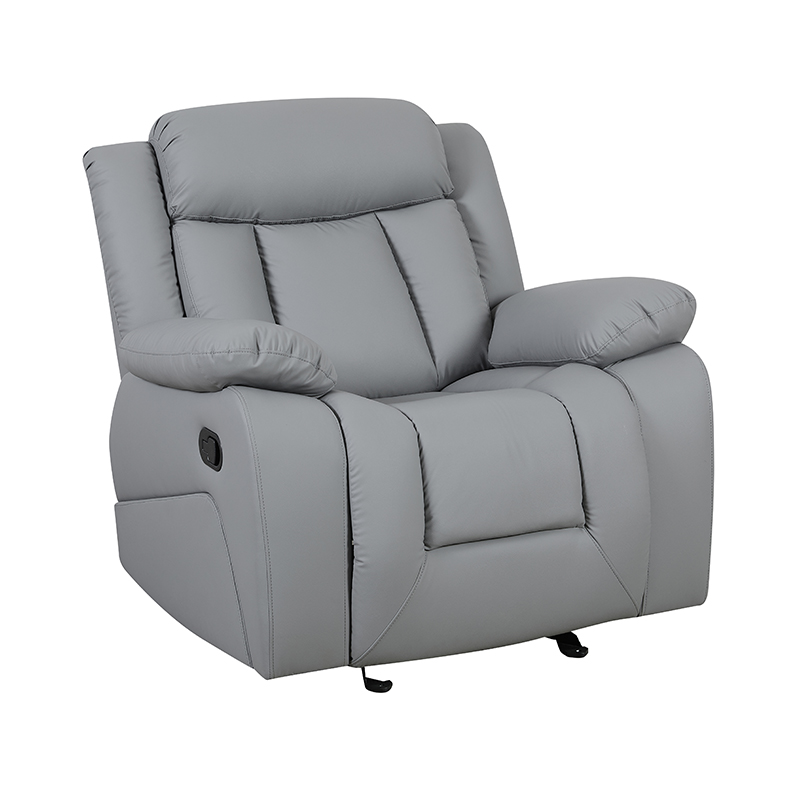
Are Fabric Recliners Easy to Clean?
A common hesitation about fabric is the question are fabric recliners easy to clean. The answer depends entirely on the fabric's cleaning code, which is printed on the tag underneath the chair. The code dictates what you can safely use:
- Code W: Water‑based cleaners only. You can use a mild upholstery shampoo and blot out stains effectively.
- Code S: Solvent‑based cleaners only. Water may cause shrinking or water rings.
- Code WS: Either water or solvent cleaners are safe, giving maximum flexibility.
- Code X: Vacuum only. No liquid cleaning agents are permitted.
Today, many mid‑range and high‑end fabric recliners use performance fabrics with a stain‑resistant finish. Spilled coffee or red wine often beads on the surface for several minutes, allowing you to blot it away before it penetrates. For routine care, a weekly vacuum with an upholstery brush removes abrasive dust that would otherwise wear the fibers. When compared to leather, fabric does require slightly more attention to liquid spills, but it does not need conditioning or protectants to stay supple. Overall, with the right code and a prompt response to accidents, a fabric recliner is straightforward to keep fresh and hygienic for years.
Are Recliner Chairs Good for Your Back?
The question are recliner chairs good for your back has a nuanced answer. When properly adjusted, a recliner can reduce spinal pressure significantly. Research on seated posture shows that reclining the backrest to 110–130 degrees and elevating the legs decreases intradiscal pressure in the lumbar spine by up to 35% compared to upright sitting. This position transfers weight from the spine to the chair’s backrest, allowing paraspinal muscles to relax. For people with chronic lower back pain, this can be therapeutic.
However, a recliner must fit your body to deliver these benefits. The lumbar support bulge should hit the small of your back at the correct height. The seat depth must not cause you to slouch to reach the backrest. A chair that is too large can cause you to curl your spine to find support, actually worsening back discomfort. Look for models with adjustable headrests and built‑in lumbar pads, and if possible, test the chair for at least 15 minutes in the exact reclined position you will use at home. When matched correctly, a recliner is not merely a comfort luxury — it is a legitimate tool for spinal decompression and relief from the constant compression of standing and upright sitting.
Why Choose a Fabric Recliner Chair?
Bringing the previous points together, there are compelling reasons why choose a fabric recliner chair over other types. Fabric offers a unique combination of thermal neutrality, grip, silent operation, and extensive customization. It is softer to the touch when you first sit down and remains comfortable for long sessions. From a safety standpoint, fabric does not become slippery, reducing the chance of sliding out of the chair when fully reclined.
Additionally, fabric chairs are generally lighter and easier to move for cleaning or rearranging furniture. They do not require the periodic conditioning that leather demands. For families, the ability to choose a machine‑washable slipcover version adds an extra layer of practicality. Modern woven fabrics are also highly resistant to pilling and fading, meaning a quality fabric recliner can maintain its appearance for well over a decade. When you factor in a lower purchase price and an equally long mechanical life, fabric emerges as the rational choice for anyone who prioritizes everyday comfort and low‑stress upkeep.
What Size Recliner Chair Do I Need and How Much Space Is Required?
Answering what size recliner chair do I need begins with your own body measurements. Seat depth should allow 5–8 cm of clearance between the back of your knee and the front edge of the seat cushion. Seat width must be at least 5 cm wider than your hips on each side. A standard recliner suits individuals up to roughly 185 cm (6 ft 1 in) tall; taller users need an extended backrest with a higher headrest position.
Equally critical is understanding how much space do you need for a recliner chair when it is fully extended. A typical wall‑hugger manual recliner needs only 10–15 cm (4–6 inches) of clearance behind it, while a traditional push‑back recliner may require 50–70 cm (20–28 inches) of clearance from the wall. The footrest, when extended, adds roughly 90–110 cm in front of the seat. Thus, a standard recliner can occupy a total operational footprint of about 180 cm deep by 90 cm wide. In a small living room, measure the available floor area with the recliner fully open, ensuring it does not block walkways or doors. A corner placement often maximizes usable space, allowing the footrest to extend into the center of the room without obstructing traffic.
How to Choose the Right Recliner for Your Living Room
The process of how to choose the right recliner for living room integrates size, style, and function. Start by assessing the room’s layout and traffic flow. The recliner must operate without bumping into sofas, coffee tables, or radiators. If space is tight, a wall‑hugger or swivel recliner saves valuable floor area. Consider the visual bulk: a dark, oversized recliner can dominate a small room, while a lighter fabric and a sleek profile can blend into the décor.
Coordinate the fabric or leather color with existing furniture. Neutral grays and beiges are safe, but a patterned fabric can tie together accent colors in rugs or cushions. Functionally, decide if you need additional features such as a rocking mechanism, a swivel base, or built‑in storage. Remember that each added feature slightly increases the chair’s footprint and weight. Finally, test the recliner in the store with your regular sitting posture — book in hand, phone nearby — and imagine how it will look and feel after three hours of evening relaxation. The chair that passes this mental test, fits your measured space, and matches your material preferences is the right one.
What Type of Recliner Chair Is Most Comfortable?
The search for what type of recliner chair is most comfortable leads to a few design variants, each with a distinct feel. The classic two‑position recliner offers upright and fully reclined, simple and sturdy. The rocker recliner adds a gentle rocking motion that many find soothing, especially for nursing or reading. The wall‑hugger recliner sits closer to the wall, conserving space without sacrificing recline. For the ultimate in custom support, a high‑leg recliner with an adjustable headrest and independent footrest operation allows infinite fine‑tuning.
Comfort also comes from the internal construction. High‑resilience foam with a density of 2.0–2.5 lb/ft³ provides firm support that does not sag. Pocketed spring seats add a premium, buoyant feel. A padded footrest extension and a contoured backrest contribute to overall body support. In practice, the most comfortable recliner is the one that fits your height, distributes pressure evenly, and allows you to breathe deeply. Before purchasing, recline fully and pay attention to any pressure points in your lower back, thighs, or neck. If the chair supports a neutral spine and your feet are fully supported without dangling, it will likely be the most comfortable choice for your specific body.
LET'S TALK

Bai Shuiwan Industrial Park, Tian Huangping Town, Anji County, Huzhou City, Zhejiang Province, China
More About Us 
-
+86 18257273741
-
[email protected]
CONTACT US
Copyright © Anji Xuanbo Household Co., Ltd. All Rights Reserved.
Custom Modern Upholstered Sofa Manufacturers


